

This article is an on-site version of our Moral Money newsletter. Premium subscribers can sign up here to get the newsletter delivered three times a week. Standard subscribers can upgrade to Premium here, or explore all FT newsletters.
Visit our Moral Money hub for all the latest ESG news, opinion and analysis from around the FT
Welcome back. As the situation in the Middle East has spiralled this week, Russia’s war in Ukraine rages on — still bankrolled in part by European payments for fossil fuels. Cutting off that flow of cash is proving a fearsomely difficult task, as I explain in today’s newsletter.
Inside the EU’s energy policy debate
To many in Europe, the case for a rapid move away from reliance on Russian gas seems unarguable. As the EU seeks to bolster Ukraine’s defence against Moscow’s invasion, how can it keep channelling huge sums towards Vladimir Putin’s war machine?
That argument is prevailing in Brussels, where officials are pressing ahead with a plan to halt all Russian fossil fuel imports from the start of 2028. The EU’s energy strategy involves a big increase in gas imports from alternative suppliers, as well as an acceleration in the shift to green energy.
But the plan does not have unanimous consensus among the 27 EU member states — with the strongest dissent coming from Viktor Orbán’s Hungarian government. That’s prompted the European Commission to develop a plan to ban Russian gas contracts using trade law, in order to sidestep a potential Hungarian veto, the FT reported this week.
Orbán’s critics have accused him of an unjustifiable level of support for the Russian regime — partly driven, they suggest, by a certain affinity with Putin’s authoritarian governance style. Orbán’s own weakening of civil liberties and the rule of law in Hungary have led to the freezing of billions of euros in EU financial support.
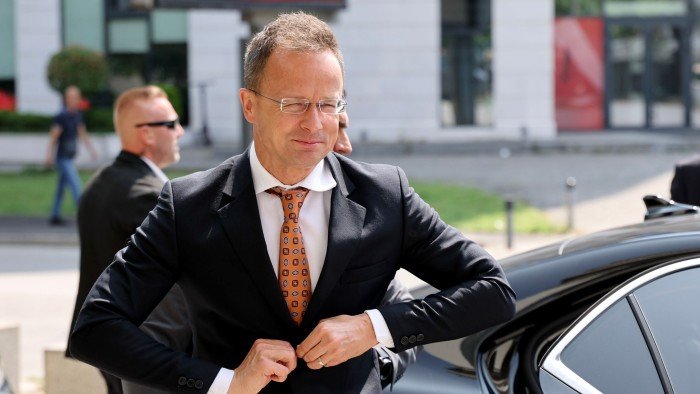
I heard Budapest’s response to this criticism set out in blistering fashion this week by Péter Szijjártó, Hungarian foreign affairs and trade minister. Szijjártó is one of Russia’s most attentive remaining friends, having made 13 trips there since the invasion of Ukraine.
But he insisted that the continued warm stance towards Moscow was driven by pragmatism about Hungary’s energy security rather than by ideology.
Critics who accuse his government of being “Russian spies, puppets of Moscow . . . know nothing about the regional physical and infrastructural realities”, Szijjártó told the FT’s Marton Dunai at the FT-Kathimerini Energy Transition Summit in Athens.
Unlike Germany or France, which have invested heavily in infrastructure for importing liquefied natural gas, “we are a landlocked country, dependent on our neighbours and their neighbours”, Szijjártó noted.
This, he said, was the key reason why Hungary continues to import the vast majority of its oil and gas from Russia. The European Commission says that purchases from Russia have fallen from 45 per cent of EU gas imports in 2021 to 19 per cent last year, while just 3 per cent of EU oil imports came from Russia in 2024. But Hungary remains heavily reliant on Russian hydrocarbons, and is now the EU’s biggest importer of Russian gas, which it receives mainly via the TurkStream pipeline that passes through Turkey and Bulgaria.
Under Brussels’s REPowerEU plan to phase out Russian energy imports — announced three months after Russia’s February 2022 invasion of Ukraine— Hungary would require a huge upgrade of its gas interconnection infrastructure with neighbouring countries. Szijjártó accused the European Commission of refusing to provide support for such investment, in part due to its broader strategy of shifting away from fossil fuels.
An effort by south-east European countries to secure EU financial assistance for an expansion of gas pipeline infrastructure was “rejected by Brussels, saying that gas is not going to be part of the energy mix in 10 years . . . it’s not trendy, not sexy anymore to use gas”, Szijjártó said.
Among the 27 EU member states, Hungary is an outlier in the continued warmth of its relations with Moscow. So too in its erosion of democratic principles — at least in the eyes of fellow EU members, as shown by the extraordinary financial pressure they have applied. Hungary’s many critics will view its resistance to the REPowerEU plan as another effort to hold a flagship strategy hostage in order to secure concessions.
But in its discomfort with EU energy policy, Budapest is far from alone. Fellow landlocked nation Slovakia has also pushed back against the effort to phase out Russian gas. Austria, another coast-free country, urged this week that the EU must be open to resuming Russian energy imports upon the end of the Ukraine war.
At this week’s conference in Athens, senior government and corporate figures from several south-east European nations — most of which have supported the end to Russian gas imports — voiced unhappiness with the gap between the expensive energy prices in their region and the cheaper rates in northern and western Europe.
“We are disadvantaged” by the failure to build a fully integrated EU energy system, said Greek Prime Minister Kyriakos Mitsotakis. “We’re doing our fair share in terms of moving towards the [energy strategy] goals. Why should we pay so much higher prices in a market that at least should aim towards price parity?”
That regional price gap stems in part from the EU’s slowness to implement market reforms and interconnection infrastructure to facilitate cross-border energy sales. It’s also in part because north-western nations have rolled out low-cost renewables at greater scale than their south-eastern peers, and have been more effective in developing physical and market connections among themselves.
The debate over responsibility for these underlying issues will rumble on, as will the arguments about Orbán’s actions at home and abroad. But however valid the ethical and security grounds for the EU’s shift away from Russian energy, it will undeniably be far more difficult and disruptive for some member states than for others. Mitigating the tensions around this will be a crucial test for EU energy strategy in the months and years ahead — and for the broader European project.
Smart reads (and a smart listen)
New man What’s the truth behind Mark Zuckerberg’s macho-man makeover?
Blood money Record high gold prices are helping to finance the continuation of Sudan’s disastrous civil war.
Stranger than fiction As a top executive at Wirecard, Jan Marsalek presided over one of Europe’s biggest and most spectacular frauds — and also turned out to be a Russian agent. The new season of the FT’s Hot Money podcast tells the extraordinary full story.
