

Unlock the White House Watch newsletter for free
Your guide to what Trump’s second term means for Washington, business and the world
The writer is director of economic policy studies at the American Enterprise Institute
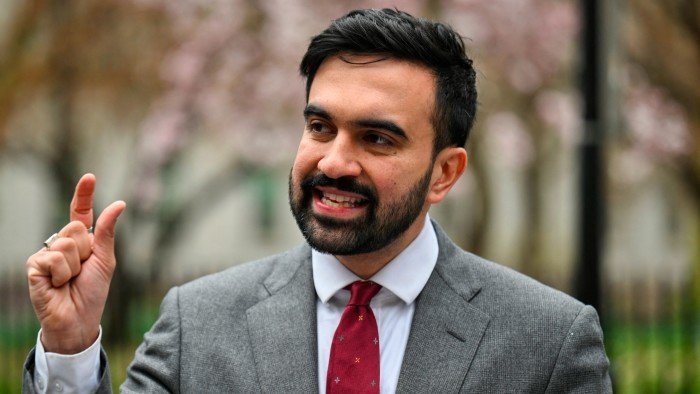
Zohran Mamdani, the democratic socialist who won last week’s Democratic mayoral primary in New York City, was asked by NBC News if “billionaires have a right to exist”. His response: “I don’t think that we should have billionaires.”
Mamdani has this backwards. We should want more billionaires, not fewer — and certainly not none.
To support his view, Mamdani argued that any one person having “so much money in a moment of such inequality” was problematic. He seems to think the economy is a zero-sum game, where if you do better it must mean that I do worse. This is profoundly mistaken. While amassing their fortunes, billionaires make the rest of us richer, not poorer.
Take Jeff Bezos, whose Venetian wedding captured the world’s attention last weekend, along with his fortune of somewhere in the region of $240bn. How has the Amazon founder made society wealthier while also generating so much wealth for himself?
The economist and Nobel laureate William Nordhaus studied the returns to innovation and concluded that innovators captured “only a minuscule fraction” of the benefits of technological advances. Nordhaus estimated this fraction to be 2.2 per cent. Applying this estimate implies that Bezos has created about $11tn in wealth for the rest of us. Not a bad deal.
This wealth takes the form of lower prices, which boost the purchasing power of wages and income for the millions of people who shop on Amazon. In addition, we are better off because we spend less time driving to and from retail stores, freeing up time to work longer hours or to be with families and friends, and because we have access to a greater variety of consumer goods.
This isn’t unique to Bezos. Even without taking philanthropy into account, billionaires make positive-sum contributions to overall welfare. Bill Gates and Michael Dell, for example, have made hundreds of millions of workers more productive by creating better software and computers, driving up their wages. Larry Page and Sergey Brin revolutionised email, internet search and mapping technology — many of us would eagerly shell out money every month for these services, if they weren’t provided by Google free of charge. Wall Street titans more efficiently allocate capital, which over time increases productivity and the wages of workers throughout the economy.
Moreover, if billionaires didn’t exist, the incentive for young people to become extremely successful would be reduced. Today’s entrepreneurs and professionals feed the aspirations of tomorrow’s leaders. A 2013 paper found that two-thirds of the wealthiest 400 Americans did not grow up in wealthy families, and that seven in 10 were the first generation in their family to run their businesses.
The debate over billionaires is part of a broader discussion over whether our system of democratic capitalism is fundamentally broken. It isn’t. One of the central moral promises of democratic capitalism is that people receive their just rewards. In our system, economic inequality is tolerable if it reflects differences in effort, risk taking, skill and choices. The evidence strongly suggests that this promise is being kept — remuneration is primarily determined by productivity.
Billionaires, then, have outsized wealth because they make outsized contributions. Income wasn’t “distributed” to them — they earned it. And the appropriate response from elected leaders is to celebrate and encourage success, not to denigrate it.
There is nothing new about Mamdani’s message, unfortunately. Senator Bernie Sanders — also a self-described democratic socialist — has previously said that “billionaires should not exist”. It is common to hear on the populist left that “every billionaire is a policy failure”. While on the right, Steve Bannon, a high priest of the Maga movement, argued in 2023 for a “massive tax increase on billionaires” to encourage fealty to US President Donald Trump.
It is outrageous to single billionaires out for punitive policies. They should not be treated as pariahs who need to be knocked down a peg or two nor as revenue-generating machines for the rest of society. Rather, they deserve to be treated as we all should be — as full citizens, with rights and duties, who both benefit from and contribute to society.
Mamdani is wrong — morally and empirically. And over the longer term, probably politically too. He ought to remember that populists who achieve executive office are often frustrated when their ideology collides with reality. If he makes it to the mayor’s office after the election in November, he will find himself wishing for more billionaires in New York — not fewer.
