

Stay informed with free updates
Simply sign up to the US economy myFT Digest — delivered directly to your inbox.
Nobody can know either the future course of the new war in the Middle East or its possible economic effects. I wrote what I could on this in a column entitled “The Economic Consequences of the Israel-Hamas War”, on October 31 2023. The big question, I argued, was whether the conflagration would extend to oil-related production and transport from the Gulf region. This region contains 48 per cent of global proved reserves and produced 33 per cent of the world’s oil in 2022. It also has a chokepoint on exports at the Strait of Hormuz. These realities remain. The question is now mostly about Donald Trump: does he know how to end this war?
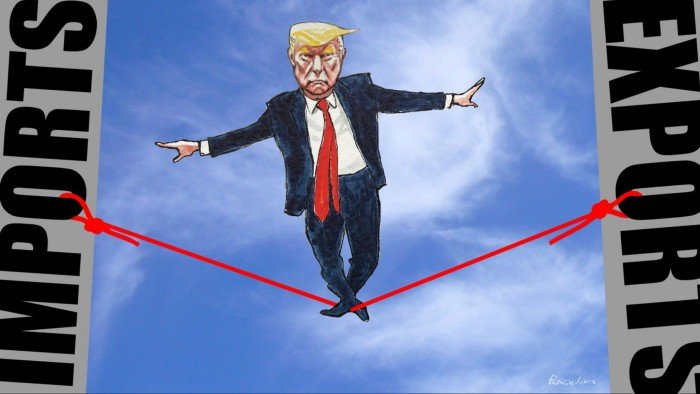
It is a question raised in other areas, too, notably the interaction of his trade policy with his fiscal policy. The aim of the former is to reduce, if not eliminate, trade deficits. The aim of the latter is to run huge fiscal deficits. These two objectives are incompatible. Large external deficits mean, by definition, that the country is spending more than its income. Since the US economy is running close to its potential, with an unemployment rate at only 4.2 per cent, no quick way to raise incomes still further exists. So reducing the external deficit will require reductions in national spending.

The obvious way to do this would be with a sustained lowering of the fiscal deficit, via higher taxes and lower spending commitments. That would allow the Federal Reserve to lower interest rates, which Trump would welcome. It should also weaken the dollar, which should help increase production of tradeable goods and services. So, apart from the fact that Trump adores low taxes and high spending, why not go for this?
The answer is that it could be worse than just politically difficult. The issue is illuminated by examination of sectoral savings and investment balances in the US economy since the early 1990s. Crucially, these have to add to zero, because domestic savings plus net foreign savings (that is, the net capital inflow) equals domestic investment. On average, the US household and corporate sectors had surplus savings of 3.5 and 1.6 per cent of GDP, respectively, from 2008 to 2023. Even from 1992 to 2007, they were close to balance. So, on a net basis, the US private sector does not need foreign savings. The dominant net borrower in the US economy is the federal government. (See charts.)

This analysis suggests that the benefit to the US of its persistent net capital inflows is the ability to have a larger fiscal deficit and so grow its public debt. This does not look like a good bargain. But if the government cut its deficit, while the external inflow continued, the outcome could be to drive the private sector into deficit, either via a slump in its income or a surge in its spending. The former means a recession. The latter means asset price bubbles. Broadly, the tendency for large and sustained inflows of foreign capital to produce wasteful borrowing, slumps, or both, is the biggest problem it creates.

In a recent paper on the issue for the Carnegie Endowment, Michael Pettis and Erica Hogan focus on another downside: they argue that suppression of consumption in China and other countries leads to huge trade surpluses and so to large deficits abroad. Countries running these trade deficits, such as the US and UK, end up with smaller manufacturing sectors than those with surpluses. But, Paul Krugman argues, even eliminating the US trade deficit would only increase US manufacturing value added by 2.5 percentage points of GDP. Trade imbalances themselves are not so important.

Pettis and Hogan also show that the size of the manufacturing sector is associated with the level of savings. But the difference between the Chinese and US average shares of manufacturing in GDP between 2012 and 2022 is 17 percentage points (28 per cent in China to 11 per cent in the US). This is far bigger than the gap between the respective trade balances. The explanation must lie with the composition of demand. Investment financed by high savings is simply very intensive in manufactures.
In sum, the main reason to worry about global trade imbalances is not the impact on manufacturing, which, for a country like the US, is a second order issue, but rather on financial stability. This is also why fiscal adjustment needs to be a co-operative venture when the participants are such big economies. Americans who focus on the fiscal deficit alone ignore its impact on global demand.

The US is likely to fail to cut its external deficit just by raising tariffs, unless protection is set at totally prohibitive levels. Otherwise tariffs just shift the composition of production, from exportables towards import substitutes, with little effect on the trade balance. Yet if it tried, instead, to close its external deficit by eliminating its fiscal deficits, it could generate a significant economic slowdown.
The US is not a small country: it has to take global repercussions into account. If it wants to accelerate a global discussion of imbalances with a policy intervention, the obvious one would not be tariffs but a tax on capital inflows. That would at least target excess foreign lending, though the entity that needs to wean itself off that is the US government.

This might, if launched, lead to a global discussion of the kind discussed in a thoughtful paper by Richard Samans for the Brookings Institution. The discussion, he suggests, should focus on fiscal, monetary, development and international trade policies. This makes sense. But it also assumes an intelligent and co-operative approach to policy. That looks unlikely.
Brandishing a stick can launch a global debate. But it is what follows the threats that matters.
