

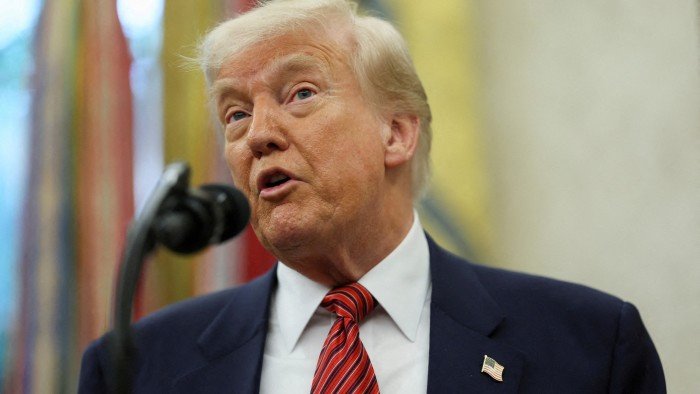
Donald Trump’s tariff announcements are giving him less and less Taco time to put them into reverse. Following an ill-evidenced accusation last Friday that China was breaking its promises on an unspecified deal, he subsequently threatened to double steel and aluminium (aluminum, whatever) tariffs to 50 per cent by this coming Wednesday. Trump said there would be no deals with trading partners to avoid them, but he always says that.
Speaking of special deals, it’s seriously bad news for the UK, which supposedly negotiated the last lot of steel tariffs away but with no date decided for lifting them. Today I look at what last week’s explosive court ruling against Trump’s tariffs means for his broader protectionist campaign. Charted Waters, where we look at the data behind world trade, is on imports to the US. Today’s reader question: will the 50 per cent steel tariffs go ahead? A simple yes or no, and only answers sent by 12 noon US eastern time count.
Get in touch. Email me at alan.beattie@ft.com
You wouldn’t like Trump when he’s angry
Last week, there was a bit of variety from the endless Trump announcements and retreats: a big tariff shock that didn’t emanate from the president directly. In this case it was the Court of International Trade declaring Trump’s use of the International Emergency Economic Powers Act (IEEPA) to be unreasonably broad.
Older readers may recall I said a while back that the courts were unlikely to rule against Trump and it probably wouldn’t stop him if they did. Well, it’s certainly true that last week’s ruling was a surprise, though not an inconceivable one. There were some exceedingly eminent scholars (the most obvious being Trade Secrets favourite Jennifer Hillman, former US trade representative general counsel) who cogently argued a couple of months ago that Trump’s use of the tariffs was an abuse of power. But at the time Hillman told me that hers was a minority view and there was no guarantee a court would agree.
I’m absolutely not going to start cosplaying a US trade or constitutional lawyer and try to predict where this goes on appeal, let alone if it eventually ends up in the Supreme Court. You can read here a long interview with Ilya Somin, the academic who deserves a lot of credit for helping bring the case to court, and a somewhat contrasting view here from the law professor Jack Goldsmith, who argues that the ruling rested on weak grounds that might not hold up in subsequent hearings.
Instead, here are my thoughts on where the political economy takes Trump from here. When he is thwarted in any way — remember the “Trump as toddler” trope from his first term? — his reaction is to lash out wildly and without logic. His outburst against the Federalist Society’s former leader for recommending to him the wrong kind of judge was particularly weird. The member of the court’s judicial panel he seems to be referring to, Tim Reif, is a Democrat who was USTR general counsel under Barack Obama and continued to work there during Trump’s first term. None of my conversations with Reif in the past convinced me he was some hardline conservative ideologue.
Where does an angry Trump go?
Trump’s habitual response to a constraint, after venting, is to ignore it or find a way round. It’s notable that his reaction to the court’s decision was to threaten to double steel tariffs, which, being “Section 232” national security duties, were not covered by the ruling.
He loves tariffs, but I’ve long suspected that if that weapon turns out to be ineffectual or gets blocked, he will quite quickly turn to other tools of international economic warfare. In fact, he already has. The nasties in his budget bill that will allow reprisals against foreign companies invested in the US were, of course, there before last week’s ruling. But they’re a warning of what happens when Trump widens the field of fire.
Despite the briefing that he’s winding up for some big, beautiful, bro-mantic deal with President Xi Jinping, Trump is already ratcheting up export controls on technology by prohibiting the sale to China of software used to design semiconductors. Export controls are a much more Joe Biden-style, technical and targeted policy (“small yard, high fence”) than broad tariffs. But even Biden, with a massively more competent and reality-based administration, couldn’t make them very effective. Trump isn’t going to make them work any better.
My fear is that Trump then moves on to something that both won’t work and will do massive economic damage if he tries. The obvious one is the dollar payments system, which he already tried to use during his first term to increase pressure on Iran and go after Huawei. This is a fairly terrifying prospect. If the Trump administration can’t competently manage to execute the task of taxing physical goods as they go through American ports — something governments have been doing literally for millennia — the thought of his administration trying to precision-target payments sanctions to reorder the world economy is chilling.
This is a good time to re-read Abraham Newman and Henry Farrell’s magisterial Underground Empire, a book on how the US weaponised various aspects of the networks connecting the global economy, including finance, data, semiconductors and data centres. (I interviewed Newman on the FT’s Economics Show podcast earlier this year.) As the authors are at pains to point out, their work is supposed to be a cautionary tale. Instead, it seems it’s being used as an operations manual.
Charted waters
Not exactly unexpected but still scary to see: US goods imports dived in April following the bogus “reciprocal tariffs” of April 2, even though some were suspended a week later.

Trade links
-
Canada’s steel producers and steelworkers are understandably furious at Trump’s latest tariff threats.
-
Investors are beginning to treat the US more like an emerging market than an advanced economy, with bond prices and the dollar falling simultaneously.
-
Inventor of the Taco trope Rob Armstrong looks at the impact of tariff revenues on Trump’s tax plans in the FT’s Unhedged newsletter.
-
Shahin Vallée at the German Council on Foreign Relations, a former adviser to Emmanuel Macron, argues that the EU should have chosen a much more aggressive response to Trump’s tariffs.
-
The FT’s India Business Briefing looks at the effect of Trump’s proposed tax on remittances sent out of the US to India.
-
Trump’s trade policy is so absurd it’s quite hard to parody it, but this excellent tariff tracker run by the German satirical website Der Postillon has a good shot.
Trade Secrets is edited by Harvey Nriapia
