

Unlock the Editor’s Digest for free
Roula Khalaf, Editor of the FT, selects her favourite stories in this weekly newsletter.
US food industry groups are pushing for exemptions from Donald Trump’s tariffs, arguing that products from fish to cucumbers cannot be affordably grown at home.
The advocacy comes as the US president hit dozens of trading partners with sweeping duties this month, driving the US’s effective tariff rate to its highest level in decades in a move that threatens to reorder global trade.
Industry groups warn that the food sector is uniquely vulnerable to tariffs because some affected countries grow ingredients that will never be produced in quantity in the US. But lobby groups are taking a piecemeal approach by pleading for exemptions rather than attacking tariffs overall.
“There are so many voices, so many products that say, ‘Well, we just need an exemption, because we’re unlike others’,” said Gavin Gibbons, chief strategy officer at the National Fisheries Institute, a US seafood trade association.
Most food consumed in the US is produced domestically by its vast farm sector. But about a fifth is imported, according to the US agriculture department.
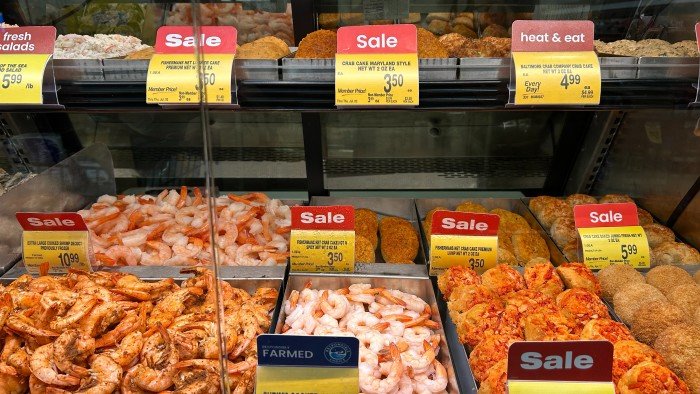
Gibbons said seafood was “fundamentally different” from other food types as 85 per cent of US consumption is fed by imports. American waters are already being fished to their maximum sustainable yield, while regulations make domestic aquaculture difficult to expand. The nation’s seafood trade deficit stood at $24bn in 2022, US commerce department data showed.
Imports account for about 90 per cent of US shrimp supply, Gibbons said, and India raises more than a third of it. Trump plans to lift US tariffs on India to 50 per cent on Wednesday as punishment for its oil purchases from Russia.
“We would like an exemption for all [seafood],” Gibbons said.

US fresh fruit and vegetable imports total $36bn, with Mexico the largest supplier overall, followed by Peru for fruits and Canada for vegetables, according to the International Fresh Produce Association (IFPA).
“We are asking for fruits and vegetables to just be out of the tariff conversation,” said Rebeckah Adcock, vice-president of government relations at the IFPA.
Nicole Bivens Collinson, managing principal at law firm Sandler, Travis & Rosenberg, said an exclusion process for food could be complicated, given there was no set process in place to apply for tariff relief.
In a letter to US trade representative Jamieson Greer late last month, the National Restaurant Association warned that menu prices would jump if tariffs were attached to fresh ingredients that were only cultivated seasonally in the US.
“We agree that our trade deficits with other countries should be more balanced, but as food and beverage products do not significantly contribute to these deficits, we are hopeful that these products can be exempt,” Sean Kennedy, an executive vice-president at the association, said in the letter.

Some food products may be exempted from Trump’s tariffs in the future. A trade framework agreed with Indonesia contains a provision that addresses unavailable natural resources.
The text of the US trade deal with the EU contains a similar provision, but does not elaborate on what goods might qualify. A 50 per cent tariff imposed on Brazil this month excluded products such as orange juice and Brazil nuts but not coffee.
Food traded between the US, Mexico and Canada also faces much lower tariffs. Trump has offered a reprieve from his higher rate tariffs on Canada and Mexico for any goods that comply with the terms of the 2020 USMCA trade deal.
US commerce secretary Howard Lutnick last month suggested that natural resources — such as coffee, mangoes and pineapples — that are not produced in the US could be given an exemption from Trump’s tariffs.
Andy Harig, a vice-president at the Food Industry Association (FMI), a grocery trade group, said that without exemptions, prices would increase considerably.
“Tariffs are designed to raise prices. Some of these are significant enough that they will raise prices by a very noticeable amount,” said Harig, whose association’s membership includes Walmart and Albertsons.
A recent FMI analysis pointed to cucumbers, a vegetable where the share of US supplies coming from imports rose from 35 per cent in 1990 to nearly 90 per cent. Cultivating 90 per cent of cucumbers domestically would require them to be grown in greenhouses for much of the year, forcing prices up.
“There is still a desire to be able to ask for exemptions, and try to turn these tariffs into a more targeted and focused kind of approach to addressing both reshoring production in the US and supporting US jobs,” Harig said.
Despite the cost of tariffs, it would be foolish and misguided “to just sort of call for the complete restoration of ’90s era free trade”, said Tom Madrecki, vice-president of supply chain resiliency at the Consumer Brands Association, which represents packaged goods companies such as PepsiCo and JM Smucker. “Philosophically, politically, that era has passed.”
