

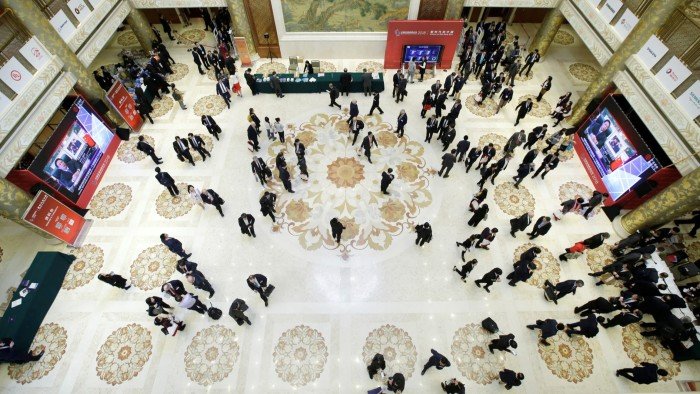
Spy balloons over the American Midwest, warnings from Beijing of a clash if Washington “doesn’t hit the brakes” and intense congressional scrutiny of investment in China — there could hardly be a less auspicious time for US business to attend Beijing’s flagship investment conference.
But this weekend, former secretary of state Henry Kissinger, investor Ray Dalio and American business chiefs including Jon Moeller of Procter & Gamble will head to Beijing for what has been billed as an opening-up party after three years of a strict zero-Covid policy.
Many of the business figures attending the China Development Forum will be seeing their mainland operations and meeting Beijing officials for the first time in three years. But while the Davos-like event is focused on “opportunities and co-operation” as the Chinese economy rebounds from the pandemic, the headwinds facing US business interests in China are also coming from Washington.
“They’re making so much money off their investments, their factories and their engagement there now that they lobby here for free on China’s behalf,” Florida senator Marco Rubio said this month of US businesses and individuals operating in China.
The full list of attendees is not available. Senior government regulators and policymakers are expected to be there, including possibly Li Qiang, Xi Jinping’s number two and the head of China’s cabinet. Panel participants and speakers include BHP chief executive Mike Henry, state-owned Bank of China president Liu Jin, PwC global chair Bob Moritz, Chinese oil company Sinopec president Zhao Dong and HSBC chief Noel Quinn, as well as several leading academics. Those from the US are expected to attract scrutiny at home.

“I don’t think the Americans are going to sit it out, but they’re probably going to do whatever they can to stay in the background and out of the limelight,” said Francis Bassolino, managing partner at Alaris Consultancy in Shanghai.
Last month, Geoffrey Siebengartner, an American Chamber of Commerce official and head of government affairs and corporate responsibility in Asia Pacific for JPMorgan, was the focus of a select committee in Washington after appearing in a video promoting Hong Kong. Beijing imposed a national security law there in 2020 that prompted sharp criticism from the US.
That incident, which followed the controversy over a Chinese balloon in US airspace, cast a chill over a mainland foreign business community that had already been isolated by the country’s strict zero-Covid policy.
In the past, the benefits of investing in China had offset the perceived risks for foreign companies of technology transfer, over-dependence on the market and political criticism, said Duncan Clark, an author and chair of advisory firm BDA China. “The difference now is that companies face much greater scrutiny from Congress,” he said.
Mark Warner, a senator who chairs the select committee on intelligence, said US private equity firms were paying more attention to lawmakers’ concerns. “We had 40 Business Roundtable CEOs and there were some more saying: ‘You know, the stuff with Taiwan really is not going to bubble up is it?’ I think we may have dissuaded them from that view,” he told reporters.
Denis Depoux, a Shanghai-based global managing director at consultancy Roland Berger, who is speaking at the forum, suggested that “everybody is more cautious on potential political implications of presence here”.
“How likely is my business impacted by American sanctions, or if not sanctions, insistent questions by bodies like Congress?” he said. “It’s [about] imagining what will come next.”
Recent earnings calls out of the US, however, show that awareness of the geopolitical landscape is tempered by optimism over the Chinese market.
Seifi Ghasemi, chief executive of Air Products & Chemicals, told Wall Street in February that “the political situation” was not affecting its operations or Chinese customers’ acceptance of its products. Colgate-Palmolive in February told analysts that its market share growth in China was “a beautiful story”, while Illinois Tool Works said last year its China revenue exceeded $1bn for the first time. “We feel very good about China,” it said.

Dale Buckner, chief executive of Global Guardian, a security consultancy, said the Russian invasion of Ukraine had prompted “more real conversations” about the risks of decoupling with China but added he was unaware of any companies leaving the country.
The geopolitical climate may counter-intuitively encourage some companies to invest more heavily in Chinese supply chains so that their operations there can stand on their own in a decoupling scenario. A 2023 report by Deloitte suggested there were multiple scenarios for companies, such as the establishment of joint ventures with either majority or minority shares for multinationals depending on how severe the decoupling was.
“China remains, arguably, the most attractive growth market in the world — for those companies able to anticipate rapid, fundamental change,” the report said.
Meanwhile, Li, the new premier of China, said this month that in his former role as head of Shanghai “senior managers of multinational corporations, including many American companies . . . all told me that they were optimistic about the future of Shanghai and China”.
“Some in the US have been trumpeting the idea of decoupling from China,” he added. “But I wonder how many people can truly benefit from this kind of hype?”
In a recent survey, the American Chamber of Commerce in China found that a record of more than half of companies polled were not profitable in China last year. But Michael Hart, its president, said this year “it looks like the economy is going in the right direction”.
He estimated half of the current crop of global chief executives had not been to China because of the pandemic.
“The China Development Forum is going to be important to see what [message] the European and handful of US CEOs [in attendance] go away with,” he said.
