

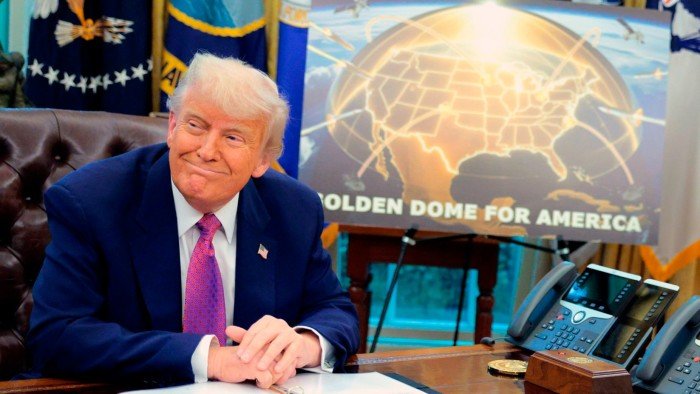
Donald Trump’s “Golden Dome” missile shield has triggered a lobbying battle between Silicon Valley and America’s biggest defence groups as they fight for a slice of the ambitious $175bn project.
The Trump administration’s explicit call for “non-traditional” contractors has fired up competition to create the experimental defence system, pitting established giants such Lockheed Martin and Northrop Grumman with tech groups trying to claim a bigger share of Pentagon funds.
As the battle is likely to draw in tech leaders from Peter Thiel to Elon Musk, the question is whether Silicon Valley truly has the defence chops to muscle further into a decades-old military industrial complex.
“I appreciate some of the aggressiveness and the entrepreneurial spirit that exists in some of these start-up entities,” said John Clark, head of technology and strategic innovation at Lockheed Martin, one of the big defence companies that helped seed Silicon Valley decades ago.
“We’d like to move as fast as anybody, but at the end of the day, we need to make sure that this stuff works,” Clark added.
The politics are suddenly also more complex. SpaceX — already among the largest tech companies working for the Pentagon — was set to be a major beneficiary of the project, but its role could be in question following the public feud between Musk and Trump.
But dozens of other tech groups, including Microsoft and Peter Thiel’s data intelligence firm Palantir, as well as all of the large legacy defence contractors, are expected to bid.
The Missile Defense Agency plans to award 10-year contracts totalling $151bn in an open, competitive process, so there will be plenty of money for newer and older players. The agency received more than 500 responses to its request for information.
Northrop Grumman executives last week held an all-hands meeting about the Golden Dome, which they see as “transformational” for the industry, said Robert Fleming, head of the group’s space division, adding the company expects to be involved in every layer of the project.
The pitch by companies such as Northrop and Lockheed is their record of delivering proven, battle-ready technologies at the kind of scale sought by Trump.
Golden Dome, inspired by Israel’s “Iron Dome”, aims to establish a space-based missile shield to protect the US against advanced missile threats from countries such as Russia and China.
The system would include sensors able to capture the entire globe in real time, space-based interceptors such as “non-kinetic” lasers that can destroy a missile seconds before launch, and generative AI models that can analyse complex data sets.

While the project aims to offer protection against new generations of ballistic and hypersonic missiles, critics argue it is unnecessary, expensive, and risks triggering an arms race. Key elements of the technology are still under development or unproven in conflict.
Defence tech start-ups have exploded in number and funding in recent years as wars in Ukraine and the Middle East, as well as geopolitical tensions between the US and China, have underlined the importance of modern technologies to national security.
Trump’s Pentagon views these companies as “vital to shaping the future of missile defence”, in part due to the rapid development of AI as well as the speed and low-cost of commercial technology innovation relative to traditional defence players.
But the legacy companies still dominate the sector and have much more experience making weapons and technology used in combat. Northrop’s Fleming emphasised the importance of differentiating between “capabilities” and “aspirations”.

Edward Abbo, C3 AI vice-president and chief technology officer, said the Golden Dome will need both hardware and software that “requires fusing data and generative and predictive AI at scale”.
“The tide is changing rapidly,” Abbo said. “Now we’re seeing the government actually preferring commercial off-the-shelf software.”
Musk’s SpaceX and Thiel’s Palantir have been working with the US government for around two decades. But they now face competition from newer entrants including Anduril, C3 AI, Epirus, Saronic, ScaleAI, ShieldAI and True Anomaly, all of which have achieved valuations over $1bn.
Mike Brown, former director of the Pentagon’s Defense Innovation Unit and current partner at venture capital firm Shield Capital, said the administration was “turbocharging how the US is buying commercial technology”.
Consumer technology companies such as Microsoft, Google and OpenAI have also ramped-up cloud and AI software offerings for US defence.
“I wouldn’t think about this as how much the primes get versus how much do these non-traditionals get. It’s how much does this help the non-traditionals catch up to the primes,” said a person close to the defence industry.
A crucial question, the person added, will be whether the Golden Dome provides a necessary “cash infusion” to develop their manufacturing and engineering capabilities as well as their understanding of war.
While legacy defence players also develop innovative tech, their pitches focus on their existing capabilities, and production and delivery records — even if they are often plagued with delays.
To create the multiple complex layers of technology and weapons systems required for the project, the Pentagon will need legacy contractors and tech groups.
“The reality is that we need both,” said Kari Bingen, who served as deputy under-secretary of defence for intelligence and security during Trump’s first term.
Michael O’Hanlon, director of the Strobe Talbott Center for Security, Strategy, and Technology at the Brookings Institution, said Silicon Valley types “are going to be very good at the battle management software” and potentially could be involved in proliferated sensor networks such as Starlink.
But O’Hanlon expressed doubt that defence tech companies had the capabilities to build larger weaponry such as interceptor missiles. “That’s different from building smaller robotics and drones, and requires more substantial dedicated resources for the prototyping and the development,” he said.
Northrop’s Fleming said the company’s established systems that hit missiles before they are launched are “critical”, as are its next-generation polar-orbiting satellites, which could be a key part of Golden Dome’s missile warning system. The group also has various proposals and “proven capabilities” for space-based interceptors, though they are classified.
Similarly, Lockheed began discussions with the Pentagon almost immediately following Trump’s January executive order calling for the construction of the Golden Dome.
In pitches to the defence department, Lockheed has highlighted its THAAD and PAC-3 missile defence systems, its long-range radar to protect against ballistic missile attacks, its portfolio of land-based radars, its Leo constellation satellites and the next-generation interceptor it is already working on.
Clark, Lockheed’s senior vice-president, said it has also been pitching what it says is its unique ability to integrate every company’s hardware and software, which will be one of the biggest challenges of the project.
Lockheed has been telling government officials that Golden Dome will involve “trying to hit a bullet with a bullet” — a message emphasising the complexity of the project.

Investors have poured more than $150bn into defence start-ups since 2021, a dramatic increase from five years earlier, according to PitchBook. However, there have so far been few signs that newer entrants have carved out a significant chunk of US defence budgets, which are overwhelmingly spent on legacy contractors such as Lockheed and Northrop.
SpaceX has Pentagon contracts worth $12.4bn, Palantir has $3.6bn of contracts — plus more than $50bn in subcontracts — and Anduril’s contracts total around $2bn, according to data provider Obviant. SpaceX also clinched a $5.9bn Navy launch contract in April.
All the defence tech companies want to “become a prime” and there will always be another start-up “waiting in the wings to then unseat them”, said Bingen.
“SpaceX went from [a] scrappy start-up to the dominant space launch provider . . . and there are others who would probably want to unseat it.”
