

Unlock the Editor’s Digest for free
Roula Khalaf, Editor of the FT, selects her favourite stories in this weekly newsletter.
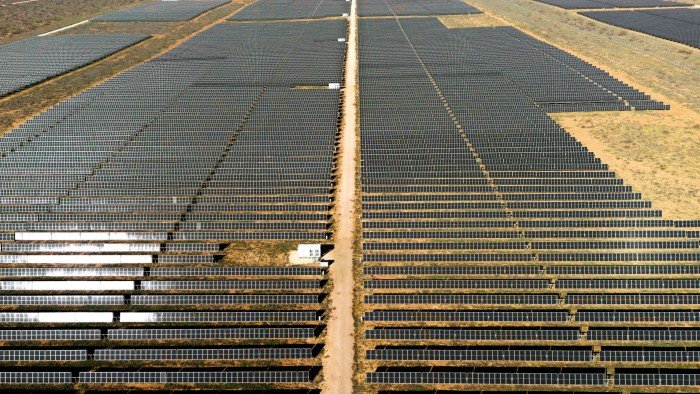
South Korean solar cells maker OCI Holdings is rapidly increasing production in the US despite President Donald Trump’s vow to slash clean energy subsidies, in what the company calls a “once-in-a-lifetime” opportunity to capitalise on power demand from data centres.
OCI, one of the world’s largest solar power developers, plans to invest $1.2bn to increase the annual cell-making capacity of its plant in Texas to 10GW by 2027 — enough to generate electricity equivalent to 10 nuclear power plants.
Increased energy requirements by data centres in the US will fuel demand for solar power and South Korean makers could fill the gap, especially as previously dominant Chinese groups are hit with tariffs, said Woohyun Lee, OCI’s chair and co-chief executive.
“A lot of big data centres are being built amid the AI boom,” Lee told the Financial Times. “We see big growth opportunities in the US given tight energy supply there. There is no other way to meet surging energy demand without solar.”
Republican lawmakers, however, have come out against clean energy, with the US House of Representatives passing a tax bill that would gut the industry and end renewable energy subsidies.
Lee said he was confident the bill would be watered down as it went through the Senate, “because US energy supply will be disrupted significantly otherwise”.
But his company would have to reconsider some of its expansion plans if Congress passed the bill in its current form, he said, as a 30 per cent tax credit for commercial projects would be gradually reduced and eliminated by 2031.
OCI is one of the few sizeable solar manufacturers operating in the US that survived a wave of bankruptcies in the 2010s, after China’s overproduction of panels dragged prices to record lows and rendered many western operations unprofitable.
The company said it could still benefit from the House bill’s restrictions on subsidies for projects that involve any “material assistance” from a “prohibited foreign entity” — a provision that mostly targets sourcing of basic materials from China.
The South Korean group has a polysilicon factory in Malaysia and plans to make wafers in south-east Asia to ship to the US for cell manufacturing.
Helped by cheap panels and subsidies, solar has become the fastest-growing source of new power generation in the US. A record 50GW of solar capacity was installed last year, comprising 84 per cent of new capacity added to the grid, according to consultancy Wood Mackenzie and the Solar Energy Industries Association.
But US solar cell production is far behind the manufacturing of panels, according to OCI, leaving an opening for the company.
Lee said data centre-driven energy demand, heavy tariffs on Chinese imports and generous subsidies from Joe Biden’s Inflation Reduction Act had enabled non-Chinese producers such as OCI to compete better with Chinese rivals in the US.
China still produces 85 per cent of the world’s solar cells and 79 per cent of polysilicon, the key material in cells. Panels made in China remain significantly cheaper at 10 cents a watt, compared with 30 cents a watt for US-made panels, according to Wood Mackenzie.
Washington has cracked down on imports of solar parts from China and Chinese companies. Biden doubled US tariffs on Chinese solar products to 50 per cent, and Trump has threatened to raise levies by an additional 10 per cent. Polysilicon and wafers from other countries have been exempt from Trump’s so-called reciprocal tariffs.
Lee said the industry needed more detailed guidelines on US regulations against foreign entities of concern and a grace period of at least three years to establish a solar supply chain away from China, given its dominance in making panels and wafers.
“Uncertainties have sharply increased with the bill, but the US energy supply market will remain very hot over the next decade,” he said.
However, Yana Hryshko, head of solar supply chain research at Wood Mackenzie, said OCI’s plans to expand its US plant capacity to 10GW in just two years was “overly ambitious”. She expected policy changes to weaken solar demand in the US.
“Building and operating solar cell capacity in the US has proven to be rather complicated,” she said. “There is very limited expertise and experience in building an operating solar cell capacity outside of China, and there is a very big difference between building the manufacturing facility and being able to produce qualified products.”
