

:max_bytes(150000):strip_icc():format(jpeg)/GettyImages-1515556-c5bc90622e654763b4dfcd3d5f924a0b.jpg)
What Is a Silver Certificate Dollar Bill Worth Today?
Silver certificate dollar bills, issued by the federal government in the late 1880s, let investors purchase silver without the hassle of storing bullion, coins, or raw metal.
Silver certificates no longer trade for actual silver, but they remain legal tender, redeemable at face value. In today’s collectors’ market, many are worth far more than what’s printed on them.
In this article, we look at the history of this unique form of currency and how much it’s worth today.
Key Takeaways
- A silver certificate dollar bill was a legal tender issued by the United States government.
- When they were first issued, certificate holders could redeem them for a certain amount of silver.
- Certificates are no longer redeemable in exchange for physical silver.
- Although collectors still seek out many of the uncommon prints, some certificates are only worth their face value.
How Silver Certificate Dollar Bills Work
Congress adopted a bimetallic standard of money in 1792, making gold and silver the mediums of exchange. Under a free coinage policy, raw gold or silver could be taken to the U.S. mint and converted into coins. However, few silver coins were minted between 1793 and 1873, as the raw silver required to make a coin was worth more than their gold dollar and greenback counterparts.
Against this backdrop, the Coinage Act of 1873 went little noticed. The act ended free coinage for silver, effectively ending bimetallism and placing the United States on the gold standard. Though silver coins could still be used as legal tender, few were in circulation. A year later, Section 3568 of the Revised Statutes further diminished silver’s status by prohibiting the use of silver coins as legal tender for amounts exceeding five dollars.
Joe Raedle / Getty Images
The U.S. government began issuing certificates in 1878 under the Bland-Allison Act. Under the act, people could deposit silver coins at the U.S. Treasury in exchange for certificates, which were easier to carry. This representative money could also be redeemed for silver equal to the certificate’s face value. In the past, other countries like China, Colombia, Costa Rica, Ethiopia, Morocco, Panama, and the Netherlands have issued silver certificates.
Old Silver Dollar Certificates
Silver’s importance became apparent with the development of the Comstock Lode and other deposits. This happened as Congress looked for ways to grow the monetary base. The U.S. went from producing less than 1% of the world’s silver to nearly 20% by the 1860s and 40% by the 1870s.
This surge in silver production set the stage for the Coinage Act of 1873, which ended free coinage of silver and moved the U.S. closer to the gold standard.
The Bland-Allison Act partially reversed that decision and reintroduced limited coinage for silver. It also required the government to purchase and coin into dollars between $2 million and $4 million worth of silver each month.
Although the certificates can no longer be exchanged for silver coins, the historical significance of the printings resides in the economic impact the certificates held, as well as the certificates’ short-term status as valid legal tender.
Obsolescence
In 1963, the House of Representatives passed PL88-36, repealing the Silver Purchase Act and instructing the retirement of $1 silver certificates. The act was predicated by a prospective shortage of silver bullion.
Certificate holders could exchange the print for silver dollar coins for approximately 10 months. In March 1964, Secretary of the Treasury C. Douglas Dillon stopped the issuance of coins, and for the next four years, certificates were redeemable for silver granules. The redemption period for silver certificates ended in June 1968.
Silver Certificate Denominations
Silver certificates are often referred to as large and small certificates. Certificates issued from 1878 to 1923 were larger in size, often measuring more than seven inches long and three inches wide. The value of large-sized silver certificates issued through 1923 ranged between $1 and $1,000. The designs varied and depicted former presidents, first ladies, vice presidents, founding fathers, and other notable figures.
The U.S. banknotes were redesigned in 1928, and, until the cessation of issuance in 1964, the silver certificates issued measured the same size as modern-day U.S. currency—about six inches long and over two inches wide. All small-sized silver certificates depict the portraits of George Washington, Abraham Lincoln, or Alexander Hamilton. In general, the value of a silver certificate is not directly correlated to its size or denomination.
Important
A silver certificate’s value is not directly correlated to its size or denomination.
Silver Certificate Value Today
The value of a silver dollar certificate is contingent on the condition and year issued. Although it is no longer possible to redeem a silver dollar certificate for silver, certificates are still technically legal tender. This means they can be exchanged for a Federal Reserve note.
Still, the actual value of a silver certificate is in its collectability. The certificates have become a collector’s item, and collectors of the certificates pay greater-than-face value, depending on the rarity of the print.
Features Adding Value
The value of each silver certificate is based on numerous variables. One of the largest determinants of the value of the bill is the grading of the certificate. Most silver certificates receive a grade on the Sheldon numerical scale, ranging from one to 70, where 70 represents a certificate in perfect mint condition.
The numerical grade corresponds with an adjectival letter that indicates one of several conditions, including: good, very good, fine, very fine, extremely fine, about uncirculated, or gem uncirculated.
In addition to the grade, there are various features found on certain silver certificates that increase their worth to a collector. In general, a silver certificate with a star in the serial number or error on the face of the bill is worth more than a silver certificate of the same year, grade, and denomination without these features.
Star notes from 1957 are common, and some collectors won’t buy them. The errors may include folding, cutting, or inking mistakes. In addition, unique and interesting serial numbers are more valuable to investors. For example, a serial number with each digit as the numeral two holds more value than a random combination of numbers.
Valuation of Silver Dollar Certificates
The most common silver certificates were issued between 1935 and 1957. Their design is nearly identical to a standard U.S. dollar bill featuring George Washington. The key difference is the text below Washington’s portrait, which states the tender is valued at one dollar in silver payable to the bearer on demand. These certificates fetch slightly more than face value, though uncirculated notes typically sell for $2 to $4.
In 1896, the silver dollar certificate carried a unique design that is known as the educational series. The face of the certificate depicts a woman instructing a young boy. The asking price for a Series 1896 $1 Silver Certificate Educational note is $500 for a print in “very fine condition 20,” while a “Gem 65” commands more than $4,000.
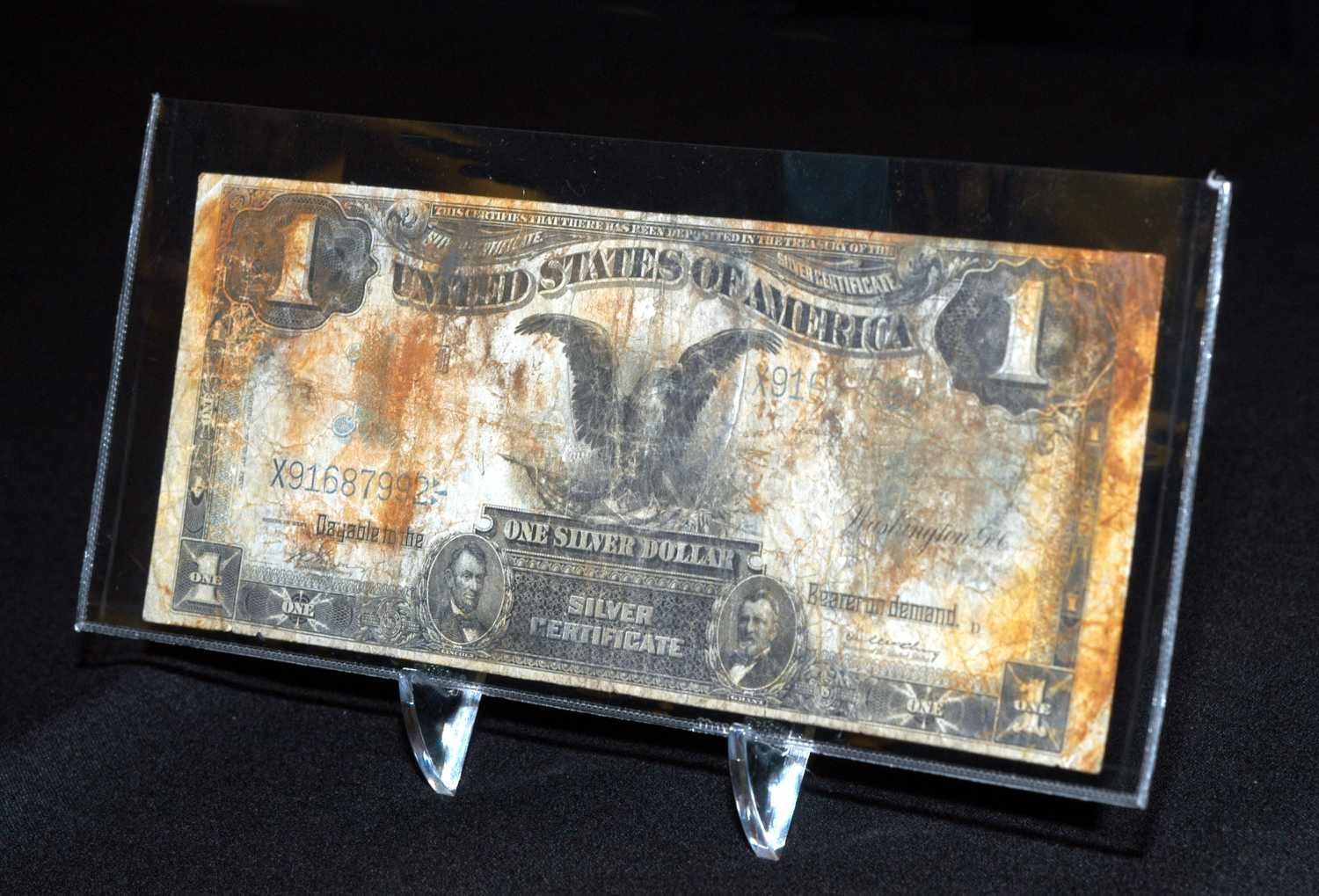
The 1899 print is another popular certificate among collectors. The note is often referred to as the Black Eagle because of the large eagle on its face. Presidents Abraham Lincoln and Ulysses Grant are found below the eagle. The asking price for a 1899 Black Eagle $1 Silver Banknote Certificate in “very good condition 8” is about $110, while a note in “gem uncirculated 65” condition fetches just above $1,300.
In 1928, the treasury issued six different silver certificates, and around 384.6 million notes went into circulation. The 1928, 1928A, and 1928B versions are common. The 1928C, 1928D, and 1928E versions are rare, with notes in “very good condition 8” fetching up to $4,500. Certificates from 1928 with a star symbol in the serial number are extremely valuable, commanding between $12,500 and $17,000 for “extremely fine condition 40.”
Alternatively, the 1934 silver certificate is considered common as it is the only year to have a blue “one” printed on its face. A 1934 certificate in “very fine condition 20” is worth around $30.
Silver Investing Options
Investors interested in an ownership share in silver should purchase the metal elsewhere. Silver certificates no longer represent an ownership stake in the commodity, and their value is mainly derived as collectors’ items. However, there are numerous alternatives for investors wanting to own silver. First, an investor can purchase the physical product through silver coins, bullion, jewelry, or silverware. Alternatively, an investor can purchase an exchange-traded fund (ETF) backed by physical silver stored in a secure location. In some situations, investors may redeem the ETF for physical silver bullion.
In addition, a speculator can invest in numerous mining or precious metal streaming companies. For example:
- Wheaton Precious Metals Corp (WPM) operates on a “streaming” model, whereby it purchases silver mined by other companies that is produced as a by-product of their main business, such as copper or gold mining.
- Silvercorp Metals (SVM) is a Canadian miner with three active sites in China.
- First Majestic Silver Corp (AG) owns three producing silver mines in Mexico.
- Hecla Mining Company (HL) owns silver mines in Alaska and Idaho, as well as Yukon Territory and Quebec, Canada.
- SSR Mining (SSRM) operates a silver mine in Argentina.
Although owning stock in these companies does not result in silver ownership, the financial success of these companies is directly tied to the price of the precious metal.
What Is the Rarest Silver Certificate?
Among the rarest silver certificate dollar bills are the 1928C, 1928D, and 1928E versions. Any notes that fall into these categories can fetch up to $4,500 as long as they’re in very good condition.
How Much Is a $1 Silver Certificate Worth?
That depends on the type of $1 silver certificate. For instance, a Series 1896 $1 Silver Certificate Educational note in very fine condition is worth about $500 while a $1 Black Eagle Silver Banknote Certificate in the same condition can fetch just around $175.
What Does “Silver Certificate” Mean on a Dollar Bill?
The term Silver Certificate represents legal tender in the form of paper currency. The certificate was once redeemable for silver, but can now be exchanged for its face value. In many cases, though, collectors will purchase them for much more.
The Bottom Line
In the past, silver certificate dollar bills gave investors a way to hold the precious metal without actually having to buy it. But the U.S. government stopped printing these notes, diminishing their importance and overall value. Although collectors will pay top dollar for some of these certificates, don’t get too excited if you find one in your billfold. Most will only get you the face value of the bill itself.
