

One thing to start: Apollo Global Management has told graduates that it will delay recruiting for junior associates until next year, after a stand-off between Wall Street banks and private equity firms over how they secure young talent.
And another thing: Credit Suisse’s former global head of asset management was accused by a board member of the now-defunct bank of giving a “false picture” of its funds tied to Greensill Capital, London’s High Court has heard.
Welcome to Due Diligence, your briefing on dealmaking, private equity and corporate finance. This article is an on-site version of the newsletter. Premium subscribers can sign up here to get the newsletter delivered every Tuesday to Friday. Standard subscribers can upgrade to Premium here, or explore all FT newsletters. Get in touch with us anytime: Due.Diligence@ft.com
In today’s newsletter:
Musk’s embarrassing climbdown
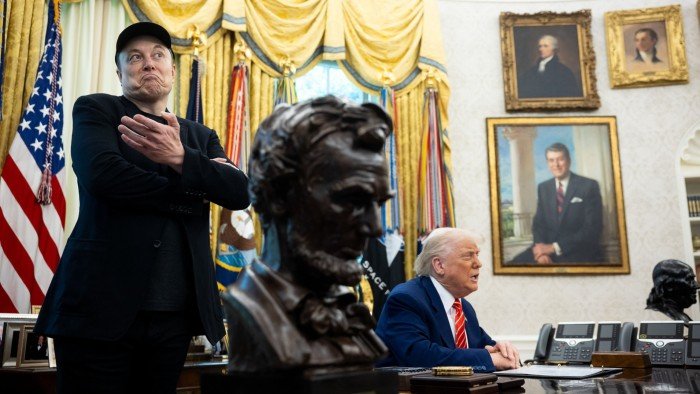
Elon Musk and Donald Trump dug in after they traded barbs last week, as the world’s richest man faced off against its most powerful.
On Wednesday, Musk blinked.
“I regret some of my posts about President @realDonaldTrump last week. They went too far,” he grovelled on X.
It’s a remarkable, if not entirely unsurprising, about-turn from the man who called for the US president to be impeached and insinuated he was associated with the late paedophile Jeffrey Epstein.
It came after Musk said Trump’s “big, beautiful” tax-cutting bill was “a disgusting abomination” and Trump last Thursday called Musk “crazy”.
Previously a donor to the Democrats, the Tesla and SpaceX founder bankrolled the Republican Trump’s bid for the presidency after souring on Joe Biden.
His choice to side with Trump appeared to pay off: this year investigations into SpaceX and Tesla launched during Biden’s tenure were put on the backburner.
But the love-in came to an untimely end after the billionaire sounded off about Trump’s tax bill, which would have undone Musk’s cost-cutting work in government.
After a week of back and forth, one thing has become clear: it’s Trump who holds the cards.
All it took for Musk to give in was a few veiled threats to his business empire.
As many others have found out, the president giveth and the president taketh away. SpaceX is reliant on the US government for contracts; Tesla’s biggest market is the US and it has faced regulatory probes for years.
Meanwhile, Musk’s xAI is in the middle of a capital raise that was blown off course by his dispute with the president. As one person conducting due diligence on the deal told DD’s Eric Platt: “You need government support.”
Musk’s capitulation came two days after a column by the FT’s Gideon Rachman, which pointed out the similarities between Musk’s fallout with Trump and the plights of Jack Ma, Mikhail Khodorkovsky and Saudi investor Prince Waleed bin Talal.
In the fight between political power and money, usually the latter comes out on top.
As Rachman put it: “The world’s richest man has discovered that he is not even the master of Washington — let alone the universe.”
Private equity meets James Bond
Companies often have small armies of advisers working on deals, conducting due diligence or research on potential targets and competitors.
One breed of these advisory groups are so-called corporate intelligence businesses: companies staffed with ex-CIA and ex-MI6 employees who have gone to the private sector to advise on thorny situations and potential transactions.
No surprise, private equity wants in on the action.
On Tuesday, Oakley Capital bought a majority stake in G3, one such group that digs up information for clients all over the world. The deal valued the company at more than £250mn, according to the FT’s Tom Wilson.
As wars rage and political uncertainty reigns, services of groups like G3 that can interpret the chaos are in more demand than ever.
“Geopolitical volatility, regulatory changes, supply chain ruptures are all driving demand,” says G3 co-executive chair Michael Bevan, formerly a managing director at HSBC.
A big part of these corporate intelligence companies’ business is leaning on employees, executives and board members’ Rolodex of contacts.
Bevan acquired the company in 2018 with Nick Alcock, a former UK diplomat in the Middle East. John Sawers, former head of MI6 and David Cohen, ex-CIA deputy director, sit on the board.
London has been the hottest spot for these sorts of groups. UK consultancy JS Held bought out corporate intelligence company GPW Group in 2022 and Africa Matters Ltd the following year.
Yet not all private intelligence companies are willing to sell themselves. Hakluyt, G3’s main rival, told the FT this year that it wanted to remain independent.
So, what do G3 and its rivals actually do? G3’s website touts that it “uncover[s] risks that transform” deal opportunities and provides insight that you would “never receive from a face-to-face meeting”.
Exactly how that’s done remains true to form — top secret.
A black eye for KKR in Japan
Japan presents a tantalising target for private equity: undervalued businesses with consistent cash flows, low net debt and a corporate culture that is warming up to the idea of M&A.
So KKR will be ruing events at Marelli, which has become one of the biggest black eyes for PE in the east Asian nation.
KKR-owned Marelli, one of the world’s largest auto parts suppliers, filed for bankruptcy this week, marking the latest turn in a fractious battle involving the PE giant, banks and leading distressed debt groups.
The debacle has been both costly and public. It’s also cast a shadow over KKR.
Marelli was created in 2019 when KKR’s Japanese car parts maker Calsonic Kansei acquired Italy’s Magneti Marelli. The deal was funded with about ¥700bn ($4.9bn) of the ¥1.1tn in debt that KKR had heaped upon Calsonic Kansei.
The business soon fell on hard times with the onset of the pandemic. Revenues plunged and in 2022 KKR was forced to write off close to $2bn, injecting a further $650mn into the business.
Haircuts of nearly 40 per cent were applied to the business’s debt.
A restructuring lowered costs and improved efficiency, but further problems came when big suppliers Nissan and Stellantis began to struggle this year.
Distressed debt investors swooped in, leading to months of creditor negotiations.
Foreign lenders led by Strategic Value Partners have pushed for a number of solutions, including providing funds if their new and old loans were made senior to other debt, writes the FT’s David Keohane.
But KKR rejected those overtures, worried that public perception could turn against it if the business fell into the hands of distressed debt owners.
Indian auto supplier Samvardhana Motherson Group — the only other bidder — submitted a “firm offer” in May, but SVP increased its own bid multiple times.
SVP’s bids eventually hit a level where other creditors were inclined to provide support, putting it in pole position for negotiations that are expected to continue in the coming weeks.
It’s a delicate challenge for KKR. A wrong step could further sully its reputation, and corporate Japan has a long memory.
Job moves
-
Consello UK has appointed Sue Gray, the former UK civil servant, as its chair. Gray was Prime Minister Keir Starmer’s chief of staff but was forced to quit in October after a power struggle in Downing Street.
-
Brookfield Asset Management has named Lowell Baron as chief executive of its real estate business. He will continue in his role as chief investment officer and replaces Brian Kingston, who will become executive chair.
-
UBS has appointed Jeremy Murphy as a managing director in its consumer and retail group in New York. He joins from Stifel.
Smart reads
AI threat WPP’s outgoing chief executive was one of the earlier adopters of AI tools for his ad agency, the FT writes. Yet AI continues to be an existential threat for the business he leaves behind.
Pay transparency Detailed pay disclosures and vigilant proxy advisers have acted as a check on US companies. That accountability is under threat, the FT’s Brooke Masters argues.
Pressure campaign Elon Musk and X chief executive Linda Yaccarino threatened legal action to push advertisers to spend money on their platform, The Wall Street Journal writes. Here’s how it played out.
News round-up
Tesla drivers in France sue over Elon Musk’s political antics (FT)
World Bank lifts ban on funding nuclear energy in boost to industry (FT)
Scania in talks to form consortium to buy Northvolt’s R&D lab (FT)
World’s biggest aircraft owner set for $1bn payout in Russian planes case (FT)
WhatsApp joins legal action against UK demand for Apple ‘back door’ (FT)
Private equity consortium strikes £1.7bn deal for NHS landlord (FT)
Telefónica plots push into cyber and data centres to clear way for deals (FT)
Leapmotor warns over setting minimum prices for China-made EVs in Europe (FT)
Due Diligence is written by Arash Massoudi, Ivan Levingston, Ortenca Aliaj, Alexandra Heal and Robert Smith in London, James Fontanella-Khan, Sujeet Indap, Eric Platt, Antoine Gara, Amelia Pollard, Maria Heeter, Kaye Wiggins, Oliver Barnes and Jamie John in New York, George Hammond and Tabby Kinder in San Francisco, Arjun Neil Alim in Hong Kong. Please send feedback to due.diligence@ft.com
