

Unlock the Editor’s Digest for free
Roula Khalaf, Editor of the FT, selects her favourite stories in this weekly newsletter.
Ministers are preparing to fast-track the redesign of London’s airspace to make room for thousands of extra flights as the UK government swings behind airport expansion in a bid to boost economic growth.
Aviation minister Mike Kane will next week lay out plans in parliament for an “Airspace Design Service” that will redraw the flight paths used by aircraft to take off and land at London airports.
“To grow the sector and deliver on expansion plans, we need to create new and more direct flight routes, so that journeys become more efficient, and airports can co-ordinate more flights, to more destinations,” Kane said in a statement to the Financial Times.
Modernising the UK’s airspace infrastructure — which was first designed in the 1950s and 1960s — promises to deliver faster flights that emit less pollution.
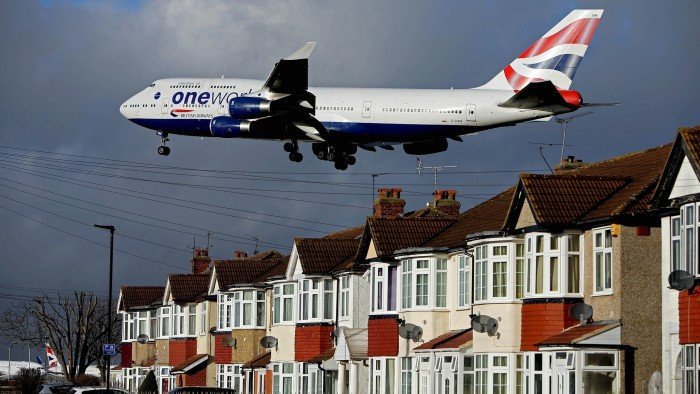
But the redesign is also likely to prove contentious: the changes to flight paths will eventually apply to all London airports, including Heathrow and Gatwick, and could expose previously unaffected communities to noise pollution.
“It is fair to say there will be winners and losers,” said one person directly involved in mapping new flight routes.
Flight paths are at present based on a fixed network of “way points”, which mirror the positions of largely obsolete ground navigation beacons established decades ago.
The system was designed in the 1950s when about 200,000 flights left and landed in Britain a year, compared with more than 2mn now.

The government has backed expansion at major London airports including Heathrow, Gatwick, Stansted, Luton and City, which would further increase the pressure on congested airspace.
A third runway at Heathrow alone could add an extra 250,000 flights a year.
Environmental groups say airport expansion is not compatible with cutting emissions, as the industry struggles to decarbonise. But Kane said it was “key to driving prosperity right across the country” and that redesigning airspace would “turbocharge” the industry’s growth.
Lee Boulton, head of airspace development at National Air Traffic Services (Nats), the UK’s air traffic control provider, said redrawing airspace would give carriers more freedom to fly direct routes using satellite navigation.
It would also spread out traffic and require far fewer interventions from air traffic controllers, he added.
The UK government has been working on airspace modernisation for a decade, but progress has been slow.
The aim of the new Airspace Design Service — overseen by Nats and first proposed by ministers and the aviation regulator last autumn — is to create a single “guiding mind” to co-ordinate changes around each airport, as well as at higher altitudes.
Boulton said redrawing the so-called highways of the sky around the capital would be “extremely complicated and extremely costly”.
“There is an awful lot of modelling and processes to compare the benefits of what you are proposing with what is there today. There are an almost infinite number of ways in which you could develop airspace,” he said.

Gatwick — which in April urged ministers to speed up approval of its proposed second runway — is already in the process of redesigning its local airspace, and the routes that planes fly between the ground and 7,000 feet.
Andy Sinclair, head of noise and airspace strategy at Britain’s second-biggest airport, said it had considered “thousands” of different routes and was preparing for a public consultation on its plans.
“The requirement in the airspace modernisation strategy is to start with a blank sheet of paper, not being encumbered by what is there today,” he said.
The priority is to reduce noise impacts when designing routes below 4,000ft, a flight’s final approach or take-off.
Local campaigners have said they still fear new flight paths and increasingly concentrated routes could hit house prices.
But airlines have welcomed the changes as a way to cut flight times, save money and fuel, and to lower emissions.
Low-cost carrier easyJet has estimated that its carbon emissions could fall by 10 per cent if it was able to fly more direct routes because of improvements to airspace across Europe.
“Airspace modernisation is the quickest and most cost-effective way to reduce carbon emissions and an essential component of how we decarbonise the industry,” said David Morgan, easyJet chief operating officer.
