Unlock the Editor’s Digest for free
Roula Khalaf, Editor of the FT, selects her favourite stories in this weekly newsletter.
Following a bit of a wobble around tariff shenanigans, corporate bond spreads are tight once more. The average single-B US corporate bond yields around 3.4 per cent more than US Treasuries — around 1.8 per cent below its long-term average.

This is despite downgrades to economic growth projections, and interest rates remaining stubbornly high. Maybe this makes sense? After all, default rates have not been particularly high.
If we’re looking for signs that the credit cycle is turning, we might be looking in the wrong place. At least, that’s the gist of a new note from Jason Thomas, Head of Global Research & Investment Strategy at The Carlyle Group.
It’s not that he’s down on credit in general. Thomas reckons tight single-B spreads reflect solid business performance. But, he argues: “[w]hat may appear as credit market complacency may instead reflect bifurcation”.
And the place to see this bifurcation in action isn’t in public bond markets. It’s in private or semi-private credit markets.
Traditional default rates in the syndicated loan market are still low. But they’ve been kept low due to rising levels of “liability management exercises”, or opportunistic debt restructurings. If you add these to the mix, Carlyle believes that syndicated loan default rates are now above long-run averages.
Furthermore, while it’s hard to get decent numbers about the opaque world of private credit, Thomas reckons there is a similar dynamic in play in direct lending:
where default rates remain low, in part, because creditors have converted struggling borrowers’ cash-pay coupons into payment-in-kind (PIK) where foregone interest accrues to the principal balance
We’ve discussed PIKs before. And as S&P Global Ratings explains:
When a borrower opts to preserve cash flow by making PIK payments, it may signal an inability to meet cash interest demands.
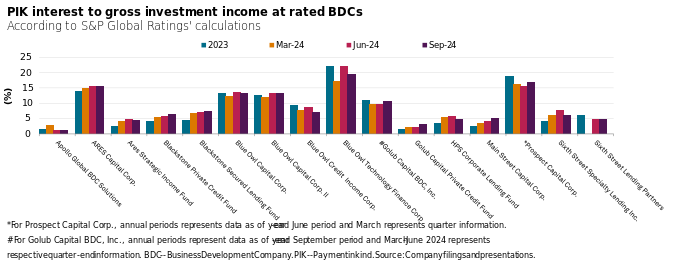
Since late 2023, PIK loans have been proliferating, with S&P Global Ratings’ estimates of the share of loans making PIK payments being just over 10 per cent in the third quarter of 2024. This was actually down on the previous quarter, though S&P expects it to rise over the rest of 2025. Their estimate is based on their analysis of 165 BDCs — business development companies, which serve as wrappers for diversified pools of private credit.
As you can see in the chart below, the proportion of income accounted for by PIKs across the 16 publicly rated BDCs varies enormously:

[Pop]
Lincoln International, a global banking advisory firm that — among other things — assembles indices to track the performance of private assets, found that by the end of Q125, around 11 per cent of debt investments tracked had some element of PIK interest, up from 7 per cent in 2021. Six per cent of deals had what they call “bad PIK” attributes — meaning that PIK interest had been added to loans that did not get done originally with PIK interest.
They think “bad PIKs” offer a decent proxy for a shadow default index, because . . .
[w]hile not all “bad PIK” borrowers are distressed … [loan to value ratios] for these deals increased from 49% at close of the investment to 86% in Q1.
There are lots of possible endings to this story.
In a good scenario, earnings grow, and interest rates fall. Creditmetrics improve, all firms come good with all their debt payments, and Forest Green Rovers win the FA Cup.
Carlyle’s Jason Thomas is less optimistic:
Creditors’ willingness to work with troubled borrowers over the past few years seems to have been influenced by the threat of companies stripping assets from lenders’ collateral pool, alongside rate cut expectations.
Moreover:
Such generosity is likely to fade as market participants come to terms with life in a new interest rate regime. As [liability management exercises] fall back into distress and equity evaporates in PIK conversions, expect default rates to move higher.
Of course, we guess everyone could just pretend that everything is fine, and kick the PIK can even further down the road.
Further reading:
— Is it PIK-up time for cash-strapped companies? (FTAV)