

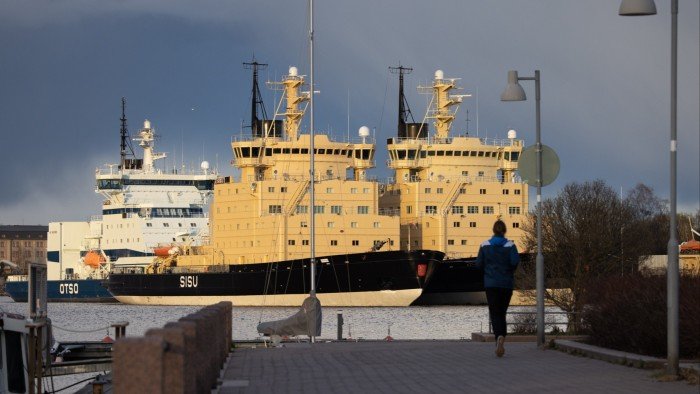
I’m very excited to have today as my respondent our Nordic correspondent, Richard Milne. He’s the perfect person to help me unpack the big announcement late last week that Finland and the US would build a whopping 11 new icebreakers together, with the first launched in 2028 — just in time for the next US presidential election. There was also news in the shipbuilding case against China (brought under section 301 of the US Trade Act), as the Office of the United States Trade Representative announced new tariffs and fees on Friday, which are (like the icebreakers) designed to bolster America’s maritime capacity in the face of new threats from both China and Russia.
Readers will know I’ve been following this story closely for some time now as I think it says something big about the new era of geoeconomics that we are entering. In my last Swamp Note on the topic, I questioned where and how icebreakers should be built, noting that it probably made much more sense to build quickly in Finland, which is the world leader in icebreaker design and manufacturing, rather than trying to scale up substandard US facilities overnight.
So, I was pleased to see that the new announcement seems quite sensible on this score. The first four ships will be built in Finland with a following seven being built in the US with Finnish help. This is, in my mind, just the way that friendshoring should be done — let allies help if they can, and make sure that there is knowledge transfer back to the US so that America can rebuild its industrial base in key areas.
As Finnish president Alexander Stubb, who has a close relationship with Trump, told me following the announcement: “This is a big deal, and the split reflects realism on how quickly [Finns] can build ships.” He also said it reflects that “the Arctic is key” to Trump, who wants to eventually match Russia’s 40 icebreakers (the US currently has only three).
Not only Russia, but also China, is becoming more active in the Arctic. This past summer, several Chinese research vessels were spotted off the coast of Alaska and in American Arctic waters. That’s a provocation that underscores how countries from the US to Canada, Russia and China are trying to exert new claims on Arctic territory, encroaching into each other’s territorial waters, and in some cases studying the size and shape of the continental shelves in order to stake claims to more territory (when I was on the US icebreaker Healy last autumn, sonar readings of the sea floor, which can be used to further such claims, were a key part of the mission).
Stubb told me that he saw this deal as “strengthening broader US-EU trade and military relations,” as well as capacity in the crucial maritime sector, which the Chinese have ringfenced in recently years. Last Friday, the USTR announced new 301 actions against China in shipbuilding, including new tariffs and service fees on cranes, which is yet another part of the maritime sector China controls.
My question to you, Richard, is this: how much does all this matter? Has the ship already sailed (sorry, I can’t help myself) on Arctic security? Is the US-Finland deal a sign of more potential for friendshoring in other areas? Are we inevitably headed for a new Great Game in the Arctic? And what might that look like?
Recommended reading
-
My colleague Gillian Tett flags a key point about Donald Trump bringing FDI back to the US. This is actually part of a larger trend in shifting FDI flows, outlined here by McKinsey Global Institute. They are being done on a far more geopolitical basis since 2015 than in the past.
-
Smart WSJ story on how Hyundai is getting the cold shoulder from Trump even as it and other Korean companies have pledged huge amounts of investment into the US. How any CEO, particularly a foreign one, does business in the US today is beyond me.
-
I often find Paul Krugman a bit repetitive and alarmist, but I don’t think that he’s overreacting when it comes to Trump’s deployment of ICE agents to Chicago, which is so scary and counter-productive. My daughter lives in the city, which she says is totally on edge. This issue isn’t getting nearly enough attention.
Richard Milne replies
Thanks for having me this week, Rana. I think this deal does matter. Covering the Arctic for the past decade or so has been fascinating — but there’s often been a sense that progress is, well, glacial. A conference about the Arctic a little while ago could have sounded quite like one 10 years earlier. Several things have changed that including Russia’s military aggression (that also involves expanding rapidly in the Arctic) as well as China eyeing the polar regions more and more.
But Trump is a big part of it too — and he’s done it in his typically brash, clumsy way. For every issue, such as icebreakers, where he’s correctly diagnosed the problem and taken action, there’s something else, like his threats to take control of Greenland from Denmark or to annex Canada.
The latter has certainly left the five Nordic countries, all of whom have an Arctic presence, shell-shocked. But they also see that Arctic security is an area where they can engage and offer something to Trump — and that maybe that can help with some of their other priorities, such as keeping the US on side with Ukraine. I certainly think that is behind what Stubb is trying to do here — and it’s definitely a great trick to offer Trump if you have the right capabilities. Norway trains a decent amount of US soldiers in what it takes to operate in the far north. And even Denmark, still reeling from Trump refusing to rule out using force to take Greenland, says again and again they want to work more with the US on Arctic security.
I think the Great Game in the Arctic has definitely started, but it will be a very long-term contest. It may well be the fastest-warming region in the world (sadly), but navigation is still tricky, and many of the much-desired resources are still pretty inaccessible. Norway’s government used to have a slogan, “high North, low tension”. Those days seem to be over, but just how high the tension will get depends on the intentions of those, like Trump, who are suddenly eyeing the Arctic.
Your feedback
We’d love to hear from you. You can email the team on swampnotes@ft.com, contact Richard on richard.milne@ft.com and Rana on rana.foroohar@ft.com, and follow them on X at @RanaForoohar and @rmilneNordic. We may feature an excerpt of your response in the next newsletter
