

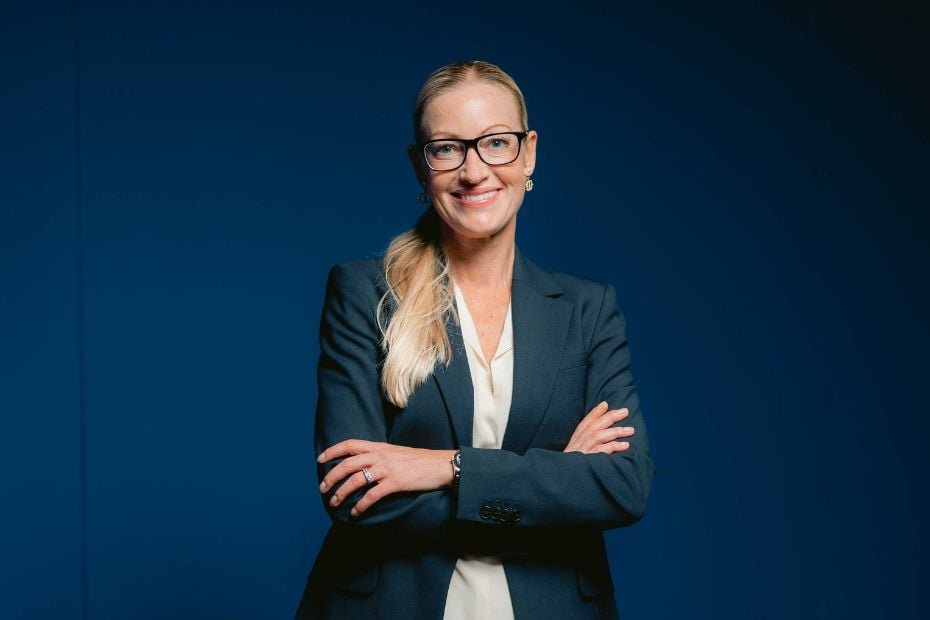

Petra Schirren, president of Ericsson Gulf at Ericsson Europe, Middle East and Africa
Ericsson’s Gulf operations are doubling down on advanced 5G deployments, Fixed Wireless Access (FWA), and sustainability-driven network innovation as the region accelerates its digital transformation agenda, according to Petra Schirren, president of Ericsson Gulf at Ericsson Europe, Middle East and Africa.
Marking her first 100 days in the role, Schirren told Gulf Business that she has focused on meeting customers, stakeholders and regulatory bodies across the region to better understand the opportunities and challenges shaping the GCC’s fast-evolving telecom landscape. “Even though I’ve been in the industry for 25 years, every region has its own flavour. What’s really exciting to see here… is the unison that operators, industries, and the government have around digitalisation, inclusion, and sustainability,” she said.
One of the most defining characteristics of the Gulf, she noted, is the speed and scale of 5G rollout. “They’ve taken a leap to really be at the forefront. They want to drive change—they don’t just want to sit around and wait for it to happen,” said Schirren. According to Ericsson’s Mobility Report, the Gulf is on track to achieve 90% 5G adoption by 2030. With most Gulf countries already among the top five globally in 5G network performance, Schirren attributes the rapid advancement to three factors: proactive government agendas, operator ambition, and the tech-savvy nature of the population. “Every single strategy I’ve seen from our customers is about being number one in performance,” she says.
Schirren pointed out that several operators in the region have already deployed 5G standalone (SA) networks, unlike many global peers. “Only about 30% of the world outside of China has built standalone 5G. That’s really where the capabilities of 5G get exposed—whether it’s slicing, APIs or differentiated connectivity,” she said.
Beyond consumer use cases, enterprises are playing a growing role in the 5G monetisation story. “With 5G, we’re moving away from just pure volume of data. It’s now about differentiated connectivity—what can we do with the network, how can we prioritise traffic for emergency services, or design offerings for gamers, or set up a dedicated slice for a Formula 1 race or a concert,” she added.
Schirren also highlighted FWA as a game-changing technology, especially for enterprise, logistics and port infrastructure in the GCC. “If deployed with large spectrum, it can be better than fixed broadband in some cases. The performance of 5G now, especially with SA, allows us to do slicing for differentiated connectivity,” she said.
From a policy perspective, the Gulf’s regulatory environment has been key to enabling this momentum. “Governments here have been very pragmatic. They’ve delivered spectrum early, avoided charging high upfront fees, and been clear that digital infrastructure is foundational to national visions. They’re more leading than learning at this point,” she said.
The region’s telecom ambitions are also being supported by local talent development. In 2024, Ericsson launched initiatives such as the Gen-E Graduate Program in Bahrain and Oman, as well as Excelerate&, a 12-month programme in collaboration with e&, focused on 5G, cloud and data science for young Emiratis.
Schirren confirmed that Ericsson is working closely with CSPs (Communications Service Providers) and ministries to bridge the digital divide. “We always do audits and analysis of the network’s performance to identify coverage holes and direct investments. It’s not just about monetisation—it’s about service for the nation,” she said.
The push for AI-led networks is gaining traction too. “We’ve built AI into most of our offerings—from self-learning algorithms in network products to automated business support tools and customer interaction models. The vision is to have an autonomous, programmable network that is faster, cheaper, and more efficient,” she said.
Sustainability
On sustainability, Ericsson has committed to halving total value chain emissions by 2030 and achieving Net Zero by 2040. “We’ve always strived for every generation of products to deliver more with less,” said Schirren. “We work closely with partners, and sustainability is now embedded in how we evaluate vendors and shape our business model.”
Initiatives like the energy-saving software deployed with Batelco in Bahrain have already cut energy consumption by 30 per cent. Ericsson’s product take-back programmes and monthly knowledge-sharing sessions further embed sustainability into its operations and partnerships. The company has also been recognised by Corporate Knights as one of the world’s most sustainable large corporations in 2024.
Looking ahead, Schirren believes the region is well-positioned to become a global digital leader. “We’re extremely proud to play such a critical role when it comes to the vision of digitisation,” she said. “We’re already seeing real-world use cases like traffic management, connected recycling, and defence connectivity. Now it’s about working with stakeholders to turn this vision into reality.”
