

Unlock the Editor’s Digest for free
Roula Khalaf, Editor of the FT, selects her favourite stories in this weekly newsletter.
China is the “engine of stability and demand” that has led to global trade being surprisingly resilient despite US President Donald Trump’s tariffs, said the boss of the world’s second-largest container shipping line.
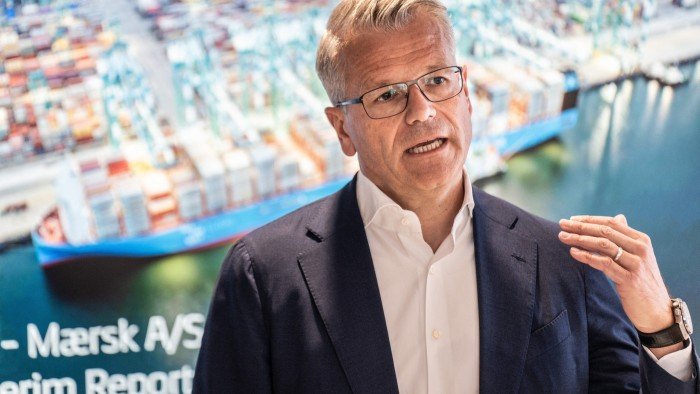
Vincent Clerc, chief executive of AP Møller-Maersk, told the Financial Times that the Danish group was lifting its financial guidance to the top end of its range due to the strength of consumer demand and confidence that any durable upending of existing supply chains would take decades.
“The resilience of consumer demand has been a surprise, and we see that the strength of China by just the level of innovation and the products that they’re bringing to market [and] is fuelling a lot of that demand. There’s no doubt that China is the engine of the stability and demand that we’re seeing today,” he added.
Trump has lifted US tariffs to their highest level in almost a century in an attempt to encourage companies to produce more in America, sparking concern about a slowdown in trade and economic growth.
But Maersk, which is seen as a bellwether on trade as it transports one-fifth of all seaborne freight, has regularly upgraded its forecast for global container demand this year since the initial shock of the “liberation day” tariffs in April.
The company said on Thursday it expected container demand to be about 4 per cent this year, up from its previous range of 2-4 per cent and well above its forecast of a possible contraction of 1 per cent in May.
That came as Maersk reported third-quarter results that beat analysts’ forecasts. Operating profit fell 61 per cent to $1.3bn — well ahead of the average forecast of $1bn. Maersk now expects full-year underlying operating profit to be $3bn-$3.5bn, compared with its previous range of $2bn-$3.5bn. It made $3.4bn in the first nine months.
Clerc said he expected a “more subdued” freight rate in the fourth quarter due to rivals bringing in new ships leading to a trickier end of the year. Shares in Maersk fell 6 per cent in morning trade on Thursday as investors fretted about future profitability.
Maersk’s chief executive said the Trump-brokered peace deal between Israel and Hamas, although “very fragile”, could turn “into something positive” and enable the reopening of the Red Sea for trade between Asia and Europe that has been diverted to a longer and more expensive route around Africa. He stressed that it was “still too early to say” when.
On Trump’s attempts to upend global production flows, Clerc said: “The supply chain is a complex and very, very entrenched thing. If you want to redraw it, this is something that doesn’t move in quarters, but years or decades. It took decades for the supply chain to end up being very Asia-centric for a lot of commodities.”
Trump has also caused uncertainty over the green transition in the shipping industry, after strong US opposition caused a delay of at least a year in adoption of new climate rules. Clerc said Maersk was fine because all of its ships can run on both traditional and greener fuels.
But he added: “It’s more from a transition perspective, from a creating a market for fuels perspective, that all of this uncertainty risks delaying some decisions and makes the journey more complicated.”
