

Unlock the Editor’s Digest for free
Roula Khalaf, Editor of the FT, selects her favourite stories in this weekly newsletter.
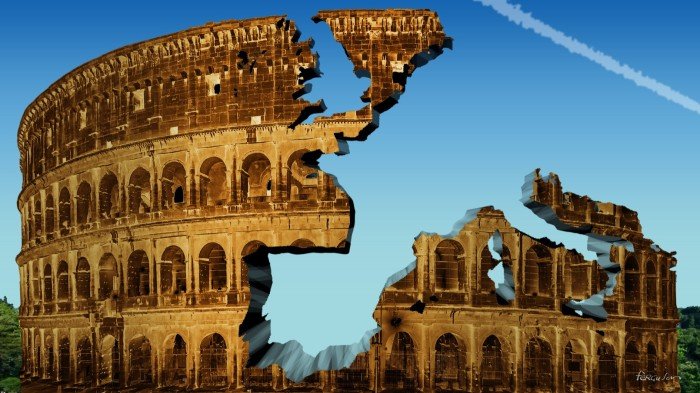
What have the Romans ever done for us? In Monty Python’s Life of Brian, the answers included aqueducts, baths and peace. But what if the right answer is: “their empire fell”? In short, western Europe’s transformative role in world history is due to the absence of a Europe-wide empire. That created what the ancient historian Walter Scheidel calls the “competitive fragmentation” of western Europe. Competition drove the commercial, intellectual, technological, legal and political changes that led in the end to the industrial revolution. Thereupon, everything changed.
The benefit of fragmentation is the central idea of Scheidel’s Escape from Rome, published in 2019. The idea was not new. But Scheidel brought it to life, by rooting the progress of western Europe in the inability of any later power to repeat what Rome did. Unlike in China, the Middle East or India, encompassing empire never returned.
For 1,500 years, European states competed with one another. Think of this as “the scorpions in a bottle” theory of European history. The scorpions needed to develop venomous stings to survive and prosper in this ferocious environment. They did so — so much so, in fact, that a small European island conquered much of the world and began the industrial revolution. Some states dropped out of the competition. But innovations and ideas repressed in some places just moved elsewhere.

Europeans created empires in the rest of the world, but not in Europe. That, argues Scheidel, is what mattered. He contrasts European competition with imperial stagnation elsewhere. Chinese and Roman empires had in common, he writes, “some degree of market integration and unevenly distributed . . . growth . . . constrained by low state capacity, pervasive elite encroachment and secular lack of innovation, human capital formation, and Schumpeterian [innovation-led] growth”. Empires provided peace, for a time, but they were rent-extraction machines. In Europe, such regimes were defeated by the ones that successfully promoted innovation.
Why did Europe remain fragmented? The answer seems to be geography — mountains and seas. Fertile areas that can support large populations and so pay high taxes were not too big and not too close. The relative military efficiency of Rome was not replicated.

In the 19th and 20th centuries, the economies of western Europe grew dramatically: in 2022, western Europe’s real GDP per head was 19 times that of 200 years before. Life expectancy also rose, from 36 in 1820 to 82 in 2020. The revolution spread from Europe across the world. The US has been the world’s leading economy since the second half of the 19th century. More recently, China’s prosperity has soared. The world has transformed. It is far richer.
Technological advances have also opened up possibilities for intense global competition. That has huge implications. Until recently, the only technologically advanced, continental-scale economy was that of the US. The Soviet Union tried to become one, but failed, except in the military domain. Today, however, China is such a power. India might become one, too. Today, then, the “bottle” is the world, not Europe, and the most dangerous scorpions are of the same size as the old empires: indeed, one of them, China, is the paradigmatic example of an ancient empire.

Where does this leave Europe, the origin of this revolution? The EU’s population is 450mn, far smaller than China’s, let alone India’s, but substantially bigger than that of the US. At PPP, its economy is smaller than those of the US and China, yet still very large. But, as noted in the Draghi report and also in “The Constitution of Innovation”, a recent paper by Luis Garicano, Bengt Holmström and Nicolas Petit, the EU and Eurozone are falling behind in productivity. It also finds it hard to mobilise its economic and demographic resources, far greater than Russia’s though they are, to guarantee its own security without the protection of the US defence umbrella.

Maybe, the EU can do what it has to do even though its history of fragmentation will always make it more of a squabbling league of sovereigns than a sovereign state. That, as the paper noted above argues, has been the promise of the “single market”: it must just try harder. One can also argue that this is true for the challenge of security, too.
Yet this is not altogether convincing. Sovereignty, national identity, politics and taxation (an expression of the others) remain firmly national. This is why completing the single market has been so hard. It is even truer of defence, where the lack of co-ordination makes freeriding inevitable.

Furthermore, economies of scale, scope and, above all, agglomeration play a huge role in the most advanced modern technologies. It is surely no accident, as Paul Krugman notes, that the digital revolution has been concentrated in Silicon Valley. Would Europeans accept (or be able to engineer) such a supercluster? One has to doubt it.
If so and if, too, this bears not just on productivity, but also on the ability to defend its security, then the conclusion might be that Europe now suffers from a paradox of its history: the fragmentation that made its states powerful and rich is, in the new world, a barrier to their remaining so. In an age of continental-scale superpowers, European fragmentation may be an insuperable handicap.
Yet a happier possibility also exists. Imperial ossification remains a threat to huge states. We see this in the over-centralisation of Chinese power and the attempted creation of a corrupt autocracy in the US. Maybe, Europeans should remain delighted that Rome fell, and despite many efforts, has never returned.
