

Stay informed with free updates
Simply sign up to the Global Economy myFT Digest — delivered directly to your inbox.
In recent years, June Fridays have often been viewed by financiers as a good moment to work from home. Not now.
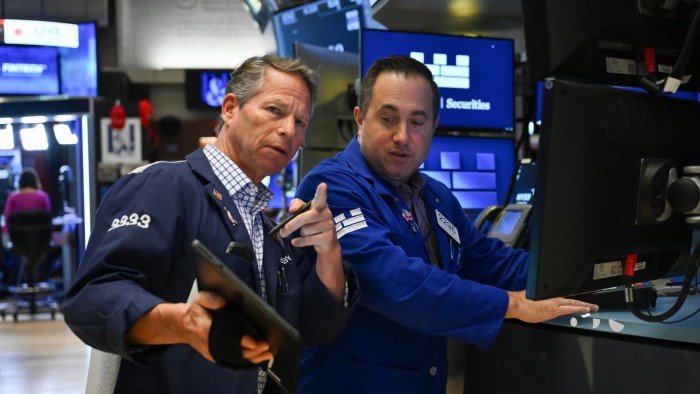
As news spread about the Israeli air strikes on Iran, traders across Wall Street and London — not to mention Asia — rushed back to their offices to prepare for the inevitable storm.
It swiftly materialised: oil prices surged (initially by around 13 per cent), stock prices fell (initially by 1 per cent in the US), and the dollar reversed its recent downward slide. And while these moves were later partly erased, volatility is likely to stay high; particularly since US President Donald Trump has warned that without a deal the next “already planned attacks” by Israel will be “even more brutal”.
So what should investors think? There is good(ish) and bad news. The former revolves around the issue of oil. At first glance, it seems reasonable to assume that higher oil prices will be a nasty blow to global growth.
For while Iran “only” produces around 1.7mn barrels of oil a day — about 2 per cent of the global total — the real threat is that if further conflict shuts the Strait of Hormuz it will undermine shipping. Indeed, ING Barings expects that in an extreme, worst-case scenario — ie a long blockage of the strait — oil prices could double to a record high of $150 later this year.
Twentieth century history has shown how damaging oil price jumps can be. And with the World Bank having just cut its outlook for global growth by almost half a percentage point to 2.3 per cent — the lowest since 2008 — now is a bad moment for another shock.
While Trump claimed on Friday that the strikes would eventually be the “greatest thing ever for the market”, the repercussions create short-term stress. High oil prices will undermine Trump’s team’s plan to drive inflation lower. It will also make it harder for the Federal Reserve to cut rates, given the risks of stagflation. For Europe, it is even worse.
But here is the good news, or at least the less depressing issue: one of the more remarkable but oft-ignored developments in recent decades is that the so-called “oil intensity” of global economies — ie the amount of barrels needed to fuel each unit of growth — has inexorably fallen.
In 1975, for example, the World Bank calculates that 0.12 “tonnes of oil equivalent” (TOE) was needed to produce $1,000 of GDP. By 2022, however, that was just 0.05, due to spreading renewable energy sources, like solar, and rising industrial efficiency.
Thus we do not face your grandfather’s — or father’s — economy, to cite the tagline. Shocks like the Israeli attack need not be as devastating as before; or not if the main transmission channel of this shock is oil.
However, the bad news is that oil is not the only transmission channel right now; instead, I suspect that the most important channel is investor psychology.
For what the Israeli strikes have done is intensify the perception that we are not just beset by rising geopolitical instability, but a zeitgeist shift too. A vicious competition for hegemonic power seems to be displacing even the fig leaf of international collaborative norms and laws.
Or, to cite Trump again, events are being driven not by a sense of universal law, but by the question of who has “the cards” (or not) of power; Israel thus feels free to bomb Iran using its military “cards”, irrespective of any UN norms.
That is disorientating — if not terrifying — for investors raised to predict the future with neat economic models. After all, in the neoliberal era those models typically excluded messy politics — and assumed that the rule of law was consistent, in the domestic and international sphere. “The traditional world order — in which economics shaped politics — has been turned on its head,” as Pimco told its clients this week: “Politics [are] now driving economics.”
So what should investors do? One essential step is to realise that while the old economic models are often useful, they are also now dangerously incomplete.
A second is to read more financial history, sociology and psychology. I personally find that useful ways to frame today’s events can be found in the writings of political scientists like Albert Hirschman and Carl Schmidt or economists John Maynard Keynes and Charles Kindleberger. Anthropologists such as David Graeber, Arjun Appadurai and James Scott help too.
Third, we must recognise that in a world where “the fragmentation of trade and security alliances is becoming a potent source of volatility”, to cite Pimco again, it is essential to diversify portfolios, take a long view of events — and a deep breath.
The bottom line, then, if you work in finance, is don’t plan many Fridays off this summer. That is not just because of rising Middle East tensions; soaring debt, currency dislocation, disrupted trade — and a US president determined to remake the global order — all present risks too. Volatility is now a feature, not a bug.
