

Unlock the Editor’s Digest for free
Roula Khalaf, Editor of the FT, selects her favourite stories in this weekly newsletter.
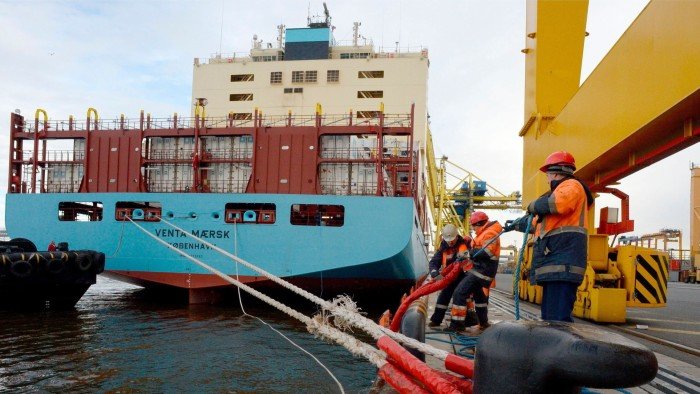
When the Venta Maersk, a ship owned by Denmark’s AP Møller-Maersk, set sail in 2018 from Vladivostok in the far east of Russia towards St Petersburg in the west, the voyage was reported as a harbinger of things to come. It was the first container ship to head for Europe from Asia via the Northern Sea Route, through the Arctic Ocean, instead of the Suez Canal. It was speculated that, as Arctic temperatures rose and sea ice cover fell, the time and cost savings would make such trips routine.
Yet, seven years on, the Venta Maersk remains the only ship from a large international container line to have used the route. In 2024, ships taking the journey handled only 3mn tonnes of cargo transiting between points outside the Arctic, according to Rosatom, the Russian state company that organises the transits. The figures are dwarfed by the 1.57bn tonnes of cargo and 26,434 trips through the Suez Canal in 2023, the last year before attacks by Yemen’s Houthis prompted rerouting of voyages.
The reluctance of most shipping lines to operate in the Arctic has cast doubt over predictions that warming in the sea there would reshape shipping patterns.
Daniel Richards, a director at London-based consultancy Maritime Strategies International, points to the risks of using the northern route. He says container shipping lines tend to be risk-averse, and their customers are similarly reluctant to have their goods enter an ecologically and geopolitically sensitive region. “That doesn’t feel likely to change in the near term,” he says.
However, Terje Jørgensen, director of the port of Kirkenes, near Norway’s border with Russia, is convinced the region can become an important trading route. He told the BBC in May about his vision to turn the lightly used port into a “Singapore of the North”, transferring containers between ships: “What we’re trying to build here in Kirkenes is a trans-shipment port where three continents meet: North America, Europe and Asia.”


Shipping lines’ willingness to use the Northern Sea Route is likely to be determined by geography, economics and geopolitics. Geography is the main point in favour, as the corridor is a far shorter means of reaching parts of Europe from Asia than alternatives. From the Japanese port of Yokohama to the Russian Arctic port of Murmansk is a journey of 12,840 nautical miles via the conventional Suez Canal route and 5,770 nautical miles via the Northern Sea Route.
The passage has also become more navigable because of climate change. Parts of the Arctic are frequently free of sea ice in summer, although many shipping lines prefer to use “ice-class” vessels with extra-strong hulls. Many rely on Russian icebreakers, provided by Rosatom, to clear the way.
Richards notes that the period with the lowest sea-ice coverage — northern hemisphere summer — is when the heaviest flows of goods come from Asia to Europe and North America, ahead of Christmas. “It might be that someone would run a few sailings per year to coincide with the peak season in the summer, offering slightly faster transit times,” he says.
Some container ships are taking the Northern Sea Route in relatively small numbers, says Richards, but they are mostly run by specialist operators with links to Russia and China. Two small container lines — NewNew Shipping, based in Dalian, China, and Hong Kong-based Safetrans Line, for example, offer services via the route.
For most shipping companies, however, the economic and geopolitical risks of operating via the Arctic outweigh any opportunity. Basil Karatzas, a New York-based ship finance specialist, says the route is “fairly isolated; it’s not year-round”.
More stories in this report
Richards says that for container ships, which follow set schedules, unpredictable weather presents “technical challenges”. It is seldom clear which parts will be ice-free and when — or if an icebreaker is required. And there are environmental concerns; since 2019, several big shipping lines have signed the Arctic Corporate Shipping Pledge, promising not to use Arctic routes to avoid polluting the area.
The route also bypasses hubs where ships drop off or pick up cargo between ports. Maersk, for example, uses hubs in Tanjung Pelepas, near Singapore; Salalah, in Oman; and on the Spanish and Moroccan sides of the Gibraltar strait to serve Asia, the Gulf and Africa.
A person familiar with Maersk’s thinking suggests its reliance on the hubs is a reason why it has not returned to the Arctic, adding that, because of sanctions, Maersk no longer does business in Russia. The route runs almost entirely through Russian waters and using it may require support from Rosatom’s icebreakers.
Karatzas suspects most lines will hold off from using the route for now: “Unless there’s a compelling reason, I think for the time being people will stay away.”
