

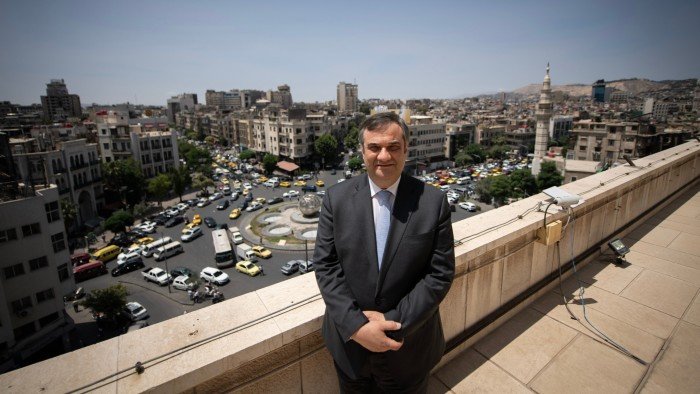
Syria will be fully reconnected to the Swift international payment system “in a matter of weeks”, the country’s new central bank governor said, relinking the country to the global economy after 14 years of war and sanctions that rendered it a pariah state.
The return of Swift is the first major milestone in the new government’s liberalising overhaul of the Syrian economy — and a sign that the new authorities are moving fast to lure international trade and investment after the US lifted sanctions last month.
In an interview in Damascus, central bank chief Abdulkader Husrieh detailed a road map for restructuring the country’s financial system and monetary policy in order to rebuild the decimated economy. He hopes to bring back foreign investment, remove barriers to trade, normalise the currency and reform the banking sector.
We “aim to enhance the brand of the country as a financial hub given the expected foreign direct investment in rebuilding and infrastructure — this is crucial,” Husrieh told the Financial Times. “While significant progress has been made, there’s still much work ahead.”

Syria has been cut off from global markets since 2011, when then-president Bashar al-Assad violently repressed a popular uprising, triggering a full-scale civil war. When Assad was overthrown by Ahmed al-Sharaa and his rebel alliance last December, the economy was in freefall and state coffers drained.
Many experts questioned whether an armed faction with little experience running a state could salvage it. But within weeks of seizing power, the new leaders outlined free market reforms to Assad’s tightly controlled economy and projected inclusion and transparency, helping court foreign investors who were initially wary of doing business with Islamist rebels.
Interim president Sharaa has built on that momentum, securing widespread support for his fledgling government from global powers keen to secure the country’s stability — despite episodic violence that has marred the transition. He received a major boost last month when US President Donald Trump unexpectedly lifted sanctions.
While that was a welcome step, “a full policy shift is still needed”, said Husrieh, who began his new job in April. “So far, we’ve only seen licence issuance and selective sanctions removal. Implementation must be comprehensive, not ad hoc.”
Husrieh, a technocrat and a longtime consultant who helped write several of Syria’s finance laws under Assad, has been working with the finance ministry on “a six to 12 month stabilisation plan”. This involves reforming banking laws and the central bank, and overhauling social security and housing financing to encourage Syrians in the diaspora to invest in the country, among other initiatives.

The banking sector is key to the rebuild, having broadly collapsed due to the war, a 2019 financial crisis in neighbouring Lebanon and punishing Assad-era policies. Husrieh wants to end the Assad regime’s interventionist legacy, and restore lending capabilities, transparency and trust.
“The central bank previously micromanaged the financial system, over-regulated lending, and restricted deposit withdrawals,” he said. “We aim to reform the sector through recapitalisation, deregulation and by re-establishing their role as financial intermediaries between households and businesses.”
Swift’s return will help encourage foreign trade, cut import costs and facilitate exports, he said. It would also bring much-needed foreign currency into the country, strengthen anti-money laundering efforts and ease the dependence on informal financial networks for cross-border trade.
“The plan is for all foreign trade to now be routed through the formal banking sector,” Husrieh said, thereby eradicating the role of money changers who would charge 40 cents of every dollar that came into Syria. He said banks and the central bank have been assigned Swift codes, and the “remaining step is for correspondent banks to resume processing transfers”.
Foreign investment will also be shored up by guarantees, he said. While the public banking sector is already fully backed by the government, Husrieh is looking to establish a state institution to guarantee private banks’ deposits.
Before Assad’s ousting, the Syrian pound had lost about 90 per cent of its value against the dollar. It has since strengthened, but is still volatile, with differences remaining between the official and black market rates. Husrieh said he aimed to unify the rates and was “transitioning towards a managed float” of the pound.
With much of the country in ruins and reconstruction costs in the untold hundreds of billions of dollars, turning around the economy is Sharaa’s biggest challenge. Syria has begun talks with the IMF, which sent a delegation to Syria last week, and the World Bank, and is seeking help from regional countries.
Saudi Arabia and Qatar cleared Syria’s $15.5mn outstanding debt to the World Bank last month, and have committed to paying at least three months of public sector salaries. Syria has also signed initial agreements with UAE, Saudi and Qatari companies for major infrastructure and power projects.
The country’s leaders have decided not to take out loans, Husrieh said. But the bank and finance ministry are exploring whether Syria could for the first time issue Sukuk, an Islamic financial certificate comparable to a bond but compliant with religious law that prohibits interest.
It has also accepted grants, including $146mn from the World Bank for the country’s power sector and $80mn from Sweden to rehabilitate its schools and hospitals.
