

Brazil is hoping to sell its first sovereign debt in the Chinese market as soon as this year, as President Luiz Inácio Lula da Silva looks to strengthen trade and investment ties with the Asian superpower.
The leftwing administration in Brasília is planning the so-called panda bond — debt issued in Chinese renminbi by a foreign borrower — and is also keen to re-enter the euro-denominated bond market, according to deputy finance minister Dario Durigan.
“The idea is that this year we’ll do both a new dollar issuance of a sustainable bond, like we did last year, as well as in Europe, and panda bonds in China,” he told the Financial Times in an interview.
“The European Union wants to negotiate with Brazil to expand our bilateral trade, whether in terms of transactions or also by offering Brazil the option of issuing its bonds in Europe,” Durigan added. “The same thing can happen with China.”
The Lula government has been trying to deepen commercial ties with Brussels and consolidate links with Beijing, amid the global trade war sparked by US President Donald Trump’s sweeping tariffs.
The Mercosur bloc of South American nations, of which Brazil is a member, hopes that a long-awaited trade deal with the EU will be approved by the end of this year. On Thursday Lula met French President Emmanuel Macron during a state visit to Paris and appealed to him to support the agreement. Macron has so far resisted ratification of the trade treaty, which is strongly opposed by French farmers.
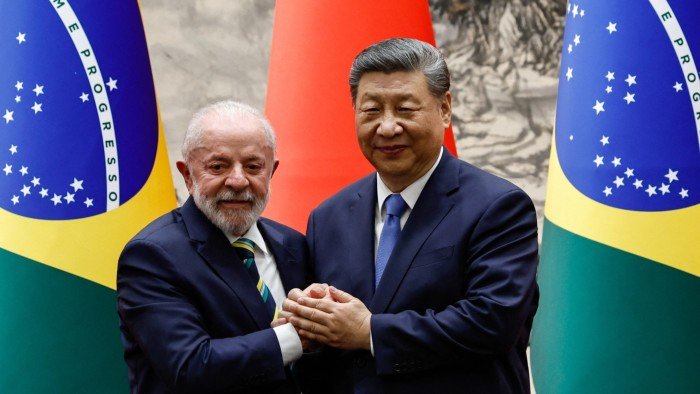
Plans for a panda bond come amid efforts to secure greater investment from China, Brazil’s largest trading partner, during a state visit by Lula last month. Beijing has also mounted a charm offensive towards Latin America as it looks to broaden its economic influence.
“In many cases I would think of [panda bonds] as a diplomatic move rather than a financial one,” said Graham Stock, emerging markets sovereign strategist at RBC BlueBay Asset Management, adding that such instruments are typically about just $200mn to $300mn in size.
The planned issuance will test international investor appetite for Brazilian debt at a time of growing market scepticism towards the policies of Lula, who has sought to increase the state’s role in the economy in an effort to boost growth and reduce inequality.
His government’s tax-and-spend approach has irked Brazilian business leaders, with critics arguing that excessive expenditure is fuelling inflation, forcing up interest rates and risking unsustainable government debt.
“Day in, day out they are thinking about new ways to spend money,” said Alberto Ramos, chief Latin America economist at Goldman Sachs. “They still need to adjust the budget deficit by three percentage points of GDP to make finances sustainable.”
Brazil primarily funds itself via domestic investors, with less than 5 per cent of its public debt denominated in other currencies — mostly dollars. Its last euro issuance was in 2014.
This week Brazil sold $1.5bn of a five-year dollar bond at a yield of 5.68 per cent and $1.25bn of 10-year debt yielding 6.73 per cent. It was the country’s second international issuance of 2025.
Issuing in renminbi would be cheaper than in reais, possibly as low as 2 per cent for 10-year debt, but that leaves currency risk, said RBC BlueBay’s Stock. Hedging this into dollars could push the rate closer to the cost of borrowing in the US currency, he added, while hedging into reais would raise it to almost 14 per cent.
Borrowing costs in Brazil have climbed as the country’s central bank has lifted its benchmark rate to 14.75 per cent in an attempt to tame inflation. Opponents accuse the government of not doing enough to tackle a chronic fiscal deficit and rising debt levels.
Durigan said the administration was on track to meet its 2025 target of a balanced primary budget, meaning before interest payments. For next year the government is targeting a primary surplus of 0.25 per cent of GDP. However, the country’s nominal public deficit, which includes interest payments, has widened under Lula to 7.8 per cent of GDP.
Nevertheless, Durigan hopes the country is edging towards investment grade status.
“We are carrying out a progressive fiscal adjustment. In other words, we are balancing the accounts with social justice,” he said.
“Our public debt problem today comes from interest,” he added. “If we start to address the fiscal situation, allowing us to provide the central bank with conditions to gradually reduce interest rates, we will be able to obtain an investment grade [rating next year].”
Goldman’s Ramos, however, was sceptical. “They won’t get investment grade next year,” he said. “They’re not even close.”
Moody’s upgraded Brazil’s long-term rating last October to one notch below the coveted status, which opens the door to cheaper capital. However, the rating agency last month revised the country’s credit outlook from positive to stable, citing slower than expected progress on fiscal policy.
With a general election next year, sceptics fear the government will resort to higher welfare payments and other giveaways ahead of the vote.
An announcement last month, designed to bolster the public finances by freezing R$31bn (US$5.5bn) in spending, triggered a market sell-off because of a poorly communicated tax increase on certain financial transactions. That reignited doubts about the government’s commitment to austerity and was perceived by some as a way to discourage money from leaving the country, although finance minister Fernando Haddad denied any intention to impose capital controls.
Barclays economist Roberto Secemski described the country’s fiscal situation as “very delicate”, given it had one of the largest debt loads among emerging markets, with gross government borrowings at 76 per cent of GDP.
“Brazil needs a primary surplus of at least 2 per cent to stabilise debt,” he said. “We’re far from that. A lot of adjustments are necessary that have been postponed and realistically will only be dealt with in the next administration.”
