

:max_bytes(150000):strip_icc():format(jpeg)/man-checking-finances-worries-b14aeb8e94b94987991abefba5c04005.jpg)
Not all debts can be discharged through bankruptcy, including child support, alimony, certain unpaid taxes, and more. Income tax debt is also very difficult, though not impossible, to get discharged. Most loan debt can be alleviated through bankruptcy.
Bankruptcy offers people who are overwhelmed by debt an opportunity for a fresh start through either liquidation (Chapter 7) or reorganization (Chapter 13). In both cases, the bankruptcy court can discharge certain debts, but not all types of them. Once a debt has been discharged, the creditor can no longer take action against the debtor, such as attempting to collect the debt or seizing any collateral.
Key Takeaways
- Types of debt that cannot be discharged in bankruptcy include alimony, child support, and certain unpaid taxes.
- Other types of debt that cannot be alleviated in bankruptcy include debts for willful and malicious injury to another person or property.
- If you don’t list a debt on your bankruptcy, it won’t be alleviated.
- Income tax debt can only be discharged in rare cases.
Chapter 7 vs. Chapter 13
Chapter 7 and Chapter 13 are the two most common types of personal bankruptcy.
In a Chapter 7 bankruptcy, a trustee appointed by the bankruptcy court will liquidate (sell off) many of your assets and use the proceeds to pay your creditors some portion of what you owe them. Certain assets are exempt from liquidation. Those typically include part of the equity in your home and automobile, clothing, any tools you need for your work, pensions, and Social Security benefits.
Your nonexempt assets that can be sold off by the trustee include property (other than your primary home), a second car or truck, recreational vehicles, boats, collections or other valuable items, and bank and investment accounts.
In Chapter 7, your debts are typically discharged about four months after you file your bankruptcy petition, according to the Administrative Office of the U.S. Courts. Bankruptcy is governed by federal law and overseen by federal bankruptcy courts, although some rules differ from state to state.
In a Chapter 13 bankruptcy, by contrast, you commit to repaying an agreed-upon portion of your debts over a period of three to five years. As long as you meet the terms of the agreement, you’re allowed to keep your otherwise nonexempt assets. At the end of the period, your remaining debts are discharged.
Fast Fact
In general, people with fewer financial resources choose Chapter 7. In fact, to be eligible for Chapter 7, you must submit to a means test, proving that you’d be unable to repay your debts. Otherwise, the court may determine that Chapter 13 is your only option.
Debts Never Discharged in Bankruptcy
While the goal of both Chapter 7 and Chapter 13 bankruptcy is to put your debts behind you, not all debts are eligible for discharge.
The United States Bankruptcy Code lists 19 different categories of debts that cannot be discharged in Chapter 7, Chapter 13, or Chapter 12 (a more specialized form of bankruptcy for family farms and fisheries).
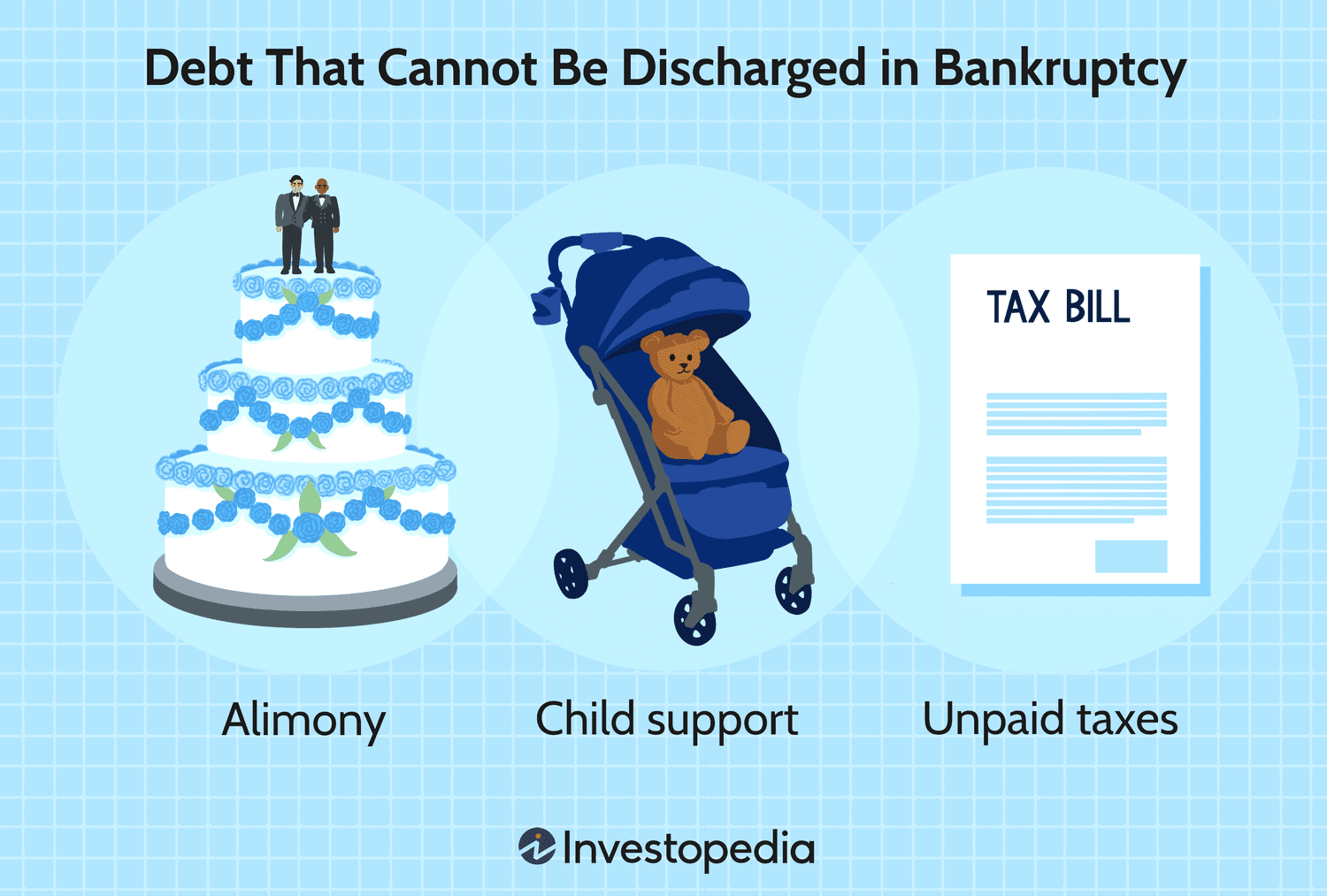
While the specifics vary somewhat among the different chapters, the most common examples of non-dischargeable debts are:
- Alimony and child support.
- Certain unpaid taxes, such as tax liens. However, some federal, state, and local taxes may be eligible for discharge if they date back several years.
- Debts for willful and malicious injury to another person or property. “Willful and malicious” here means deliberate and without just cause. In Chapter 13 bankruptcy, this applies only to injury to people; debts for property damage may be discharged.
- Debts for death or personal injury caused by the debtor’s operation of a motor vehicle while intoxicated from alcohol or impaired by other substances.
- Debts that you failed to list in your bankruptcy filing.
If you file for a Chapter 7 bankruptcy, then you’ll also continue to owe any condominium or cooperative association fees, along with any other debts that weren’t discharged in a prior bankruptcy.
You can usually keep your car by reaffirming your auto loan and continuing to make payments. Similarly, you can usually keep your home if you declare bankruptcy, even if you owe money on it, so long as you continue making the payments and don’t have more equity than you’re permitted under state and federal bankruptcy laws.
Investopedia / Ellen Lindner
Important
If you have income tax or student loan debt, then you may be able to negotiate a workable repayment plan without filing for bankruptcy. Some student loan debt may be dischargeable by filing a separate suit called an adversary proceeding. This action aims to establish that repaying student loans presents an “undue hardship.”
Debt That’s Difficult to Discharge in Bankruptcy
You cannot have income tax debt discharged without a special exemption, which can only be obtained by petitioning the bankruptcy court and explaining why you deserve relief. So if you have income tax debts that you cannot repay, then you may be better off consulting with a tax attorney to discuss your options before filing for bankruptcy.
In the case of federal taxes, for example, the Internal Revenue Service (IRS) can offer several alternatives to people who are unable to pay what they owe. One is an offer in compromise, in which the IRS agrees to accept a lesser amount. The IRS may also arrange for a payment plan, or an installment agreement, that will allow you to pay your taxes over an extended period of time.
Important
Your creditors can stop certain debts from being discharged. They may also ask the court for relief from the automatic stay that prevents them from pursuing collection activity.
Debt Relief Alternatives to Bankruptcy
Bankruptcy has serious consequences. A Chapter 7 bankruptcy will remain on your credit reports for 10 years, while a Chapter 13 will remain for seven years. That can make it more expensive or even impossible to borrow money, such as for a mortgage or car loan, or obtain a credit card. It can also affect your insurance rates.
So it’s worth exploring other types of debt relief before filing for bankruptcy. Debt relief typically involves negotiating with your creditors to make your debts more manageable, such as reducing the interest rates, canceling some portion of the debt, or giving you longer to repay. Debt relief often works to the creditor’s advantage as well, as they’re likely to get more money out of the arrangement than if you were to declare bankruptcy.
You can negotiate on your own or hire a reputable debt relief company to help you. As with credit repair, there are scam artists who pose as debt relief experts, so be sure to carefully research any company that you’re considering. Investopedia publishes a regularly updated list of the best debt relief companies.
Is It Better to Claim Bankruptcy or Settle Debt?
Debt settlement and bankruptcy can both help you achieve a fresh start by eliminating debts that you cannot pay. However, they’ll also both negatively impact your credit score. Bankruptcy can be a faster process, and you may be able to completely wipe out your debts. Debt settlement, on the other hand, can stretch on for months and doesn’t usually result in total elimination of the debt. If you work with a debt settlement company, you’ll also be charged hefty fees.
What Is the Downside of Filing for Bankruptcy?
Bankruptcy’s main downside is that it’ll remain on your credit report for up to 10 years and negatively impact your credit score. This can make it more difficult to get approved for loans or get the best interest rates on most loans, including mortgages, auto loans, and personal loans.
Can You File for Bankruptcy for Student Loans?
Student loan debt was previously difficult to discharge through bankruptcy. This was because debtors had to go through an additional step of suing the government to prove that their student loans caused “undue hardship,” which used to be costly and difficult. However, new guidance instituted by the U.S. Department of Justice in November 2022 has standardized and streamlined the process.
The Bottom Line
Bankruptcy can help you eradicate debt that has become unmanageable to the point where you cannot pay it. However, it doesn’t cover every type of debt, and it has some downsides to keep in mind, including the long-term impact on your credit score. Weigh all your options as well as the pros and cons of filing for bankruptcy before you take action, and consider consulting with a professional financial advisor.
