

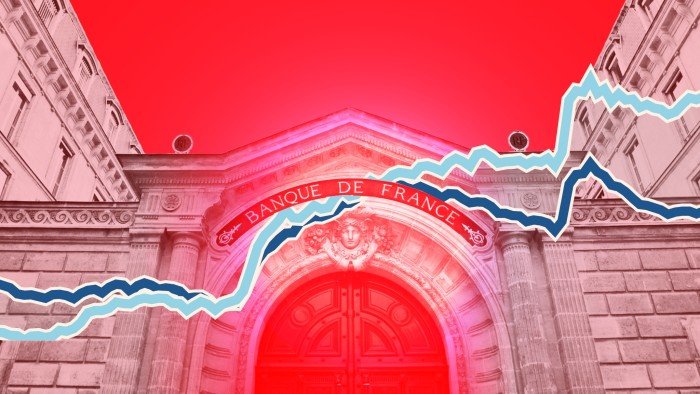
French debt has surged, deficits are widening and two prime ministers have fallen trying to fix it.
The question that now hangs over politics in Paris: how much of the budget trouble is of French President Emmanuel Macron’s own making?
Since Macron entered the Élysée in 2017 promising to cut taxes, boost growth and shrink the state, public spending has climbed — and so has France’s debt-to-GDP ratio, now trailing only Greece and Italy in the Eurozone.
Last year’s budget shortfall hit 5.8 per cent, the highest of all Eurozone countries. François Bayrou, the second premier this year to walk the plank over deficit plans, attempted a €44bn fiscal package that will now certainly have to be scaled back by his successor.

The blame game between Macron’s centrists and an angry opposition will make budget compromises difficult.
The president’s modernising approach did deliver some results. Unemployment has fallen as strict labour laws were loosened, France’s reputation as an investment destination has improved, and a raised retirement age to 64 has kept more older people working.
But the leftwing Socialist party, which is the key swing bloc if any government is to pass a budget, now demands that Macron make concessions that he sees as tantamount to unpicking much of that legacy. The Socialists want to raise taxes on the very wealthy and suspend the president’s hard-fought pension reform.

France’s dire public finances can be explained by two factors, according to economists: its big-spending approach to blunt the impact of the Covid pandemic and subsequent European energy crisis, but also sweeping tax cuts rolled out by Macron from 2018.
Half of the increase in France’s overall debt since 2017 was due to those permanent tax cuts, with crisis support accounting for the other half, estimated Xavier Ragot, who heads the OFCE think-tank.
“Macron bears some responsibility and has made mistakes,” said François Ecalle, a former finance ministry official and expert on French public finances.
But “this is an old story with deep cultural reasons — the French demand more help and protection from the state, yet also demand less tax,” he added. “It’s incoherent.”

France has not balanced a budget since the 1970s. It has always been an outlier among developed economies for the scale of public spending, which at 57 per cent of GDP in 2023 outstripped that of any other member of the OECD. It also has one of the highest tax takes, with the burden falling mostly on workers.
For a long time, successive governments saw this as an acceptable political choice, with relatively healthy growth in productivity and GDP helping to prevent debt spiralling out of control. Taxpayers were willing to support generous pensions and social security as part of the cherished French social contract, and they valued their public services.
Last year, 47 per cent of all outlays were spent on pensions, health and unemployment benefits, 20 per cent on local government, and 34 per cent on the budget of the state, according to the finance ministry.

When Macron entered the Élysée, debt was on a downward trajectory and the deficit was 3.4 per cent of GDP, thanks to measures taken by his Socialist predecessor François Hollande to recover from the 2008 financial crisis.
Hollande raised taxes on companies and households, but also created generous research and development tax credits, and incentives to hire.
“There was fiscal space,” said Ragot. “[Macron] was able to cut some taxes at the beginning and still have the deficit down in 2019, and it was expected you could do so.”

Macron scrapped a wealth tax and replaced it with a more modest one on real estate holdings, while taxes on capital income were also reduced with a flat tax of 30 per cent. Corporate taxes were cut from 33 per cent to 25 per cent, and production taxes that dented competitiveness were curbed.
This led to the left slamming Macron as the “president of the rich”, even though the elimination of a housing tax, which benefited all property owners, was among the most costly of the moves.
The tax cuts were largely unfunded because Macron’s bet was that his policies would strengthen the economy and improve labour force participation, which would boost receipts and narrow deficits.
“This was always his mindset — he never wanted to attack public spending or the workings of the state,” said Philippe Dessertine, an economist at IAE Paris Sorbonne Business School. “The tax cuts were needed to improve competitiveness, but they should have been paid for with structural reforms,” he added.
Then came a series of crises to which Macron’s response was to repeatedly take out the cheque book. First, the gilets jaunes movement flared in 2018 over a proposed carbon tax on fuels, which enraged protesters who felt his tax policy favoured the wealthy.

Then the Covid-19 pandemic and European energy shock hit in swift succession — leading the government to spend heavily on crisis support to bolster workers’ wages, keep companies afloat and help households pay the bills.
While the Covid-19 response of €170bn, or 10 per cent of GDP, was not out of whack with other countries, France kept the aid flowing for longer than its peers under its “quoi qu’il en coûte” (whatever it takes) mantra.
During the European gas crisis, the government showered consumers and businesses with untargeted energy and petrol subsidies. The French national auditor put the net cost to the state at €72bn.
Economists say the fiscal stimulus was overdone. But the OFCE suggests that the more lasting problem — which only became fully apparent as the distortions of the pandemic eased — was a fall in the tax take due to Macron’s earlier decisions.

Many economists failed to see this coming because of the turbulence of the crisis years, which made forecasting difficult, said Ragot.
Such challenges meant the finance ministry botched its tax revenue forecasts last year, leading France to far overshoot its deficit target.
Given its already high tax levels, uncertain productivity growth and stalling labour market, economists say France will not be able to quickly grow or tax its way out of its fiscal quagmire.
A sustained effort to cut public spending in many areas was needed, said Xavier Jaravel, president of the French government’s Council of Economic Analysis. This includes in health and education, where France’s higher outlays have not led to better outcomes than elsewhere in Europe.
“There are not one or two measures that can bring us to reduce the deficit enough. We need an array of measures,” he said.
The task might be manageable, if there was political backing for gradual cuts over a number of years. But given the chasm that now separates political parties, achieving consensus will probably be impossible until the 2027 presidential election allows voters to choose.
Cutting the deficit is “not an economic impossibility at all and it does not have to be an incredibly painful adjustment”, said Hélène Rey, professor at the London Business School.
