

:max_bytes(150000):strip_icc():format(jpeg)/dotdash_Final_What_Is_Purchasing_Power_Parity_PPP_May_2020-01-d820977667e14964ab1b3538e0af520c.jpg)
What Is Purchasing Power Parity?
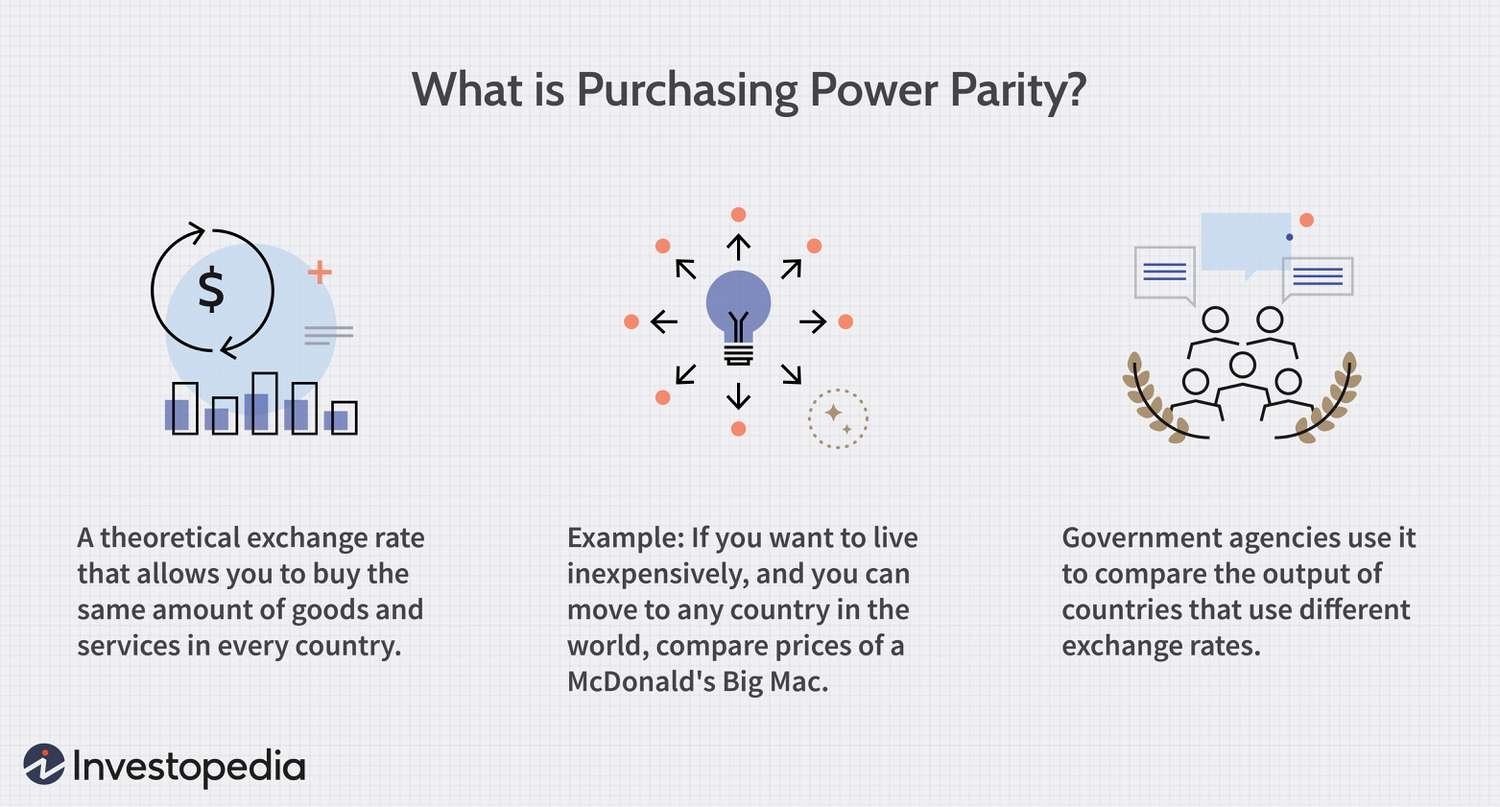
Purchasing power parity (PPP) is a popular macroeconomic analysis metric used to compare economic productivity and standards of living between countries.
PPP involves an economic theory that compares different countries’ currencies through a “basket of goods” approach. That is, PPP is the exchange rate at which one nation’s currency would be converted into another to purchase the same and same amounts of a large group of products.
According to this concept, two currencies are in equilibrium—their currencies are at par—when a basket of goods is priced the same in both countries, taking into account the exchange rates.
Key Takeaways
- Purchasing power parity (PPP) is a popular metric used by macroeconomic analysts that compares different countries’ currencies through a “basket of goods” approach.
- PPP allows economists to compare economic productivity and standards of living between countries.
- Some countries adjust their gross domestic product (GDP) figures to reflect PPP.
- Some feel that PPP does not reflect reality due to differences in local costs, taxes, tariffs, and competition.
Calculating Purchasing Power Parity
The relative version of PPP is calculated with the following formula:
S=P2P1where:S= Exchange rate of currency 1 to currency 2P1= Cost of good X in currency 1
How PPP Is Used
To make a meaningful comparison of prices across countries, a wide range of goods and services must be considered. However, the one-to-one comparison is difficult to achieve due to the sheer amount of data that must be collected and the complexity of the comparisons that must be drawn.
To help facilitate this comparison, the University of Pennsylvania and the United Nations joined forces to establish the International Comparison Program (ICP) in 1968.
Users of PPP
With this program, the PPPs generated by the ICP have a basis in a worldwide price survey that compares the prices of hundreds of various goods and services. Thus, the program helps international macroeconomists estimate global productivity and growth.
Every few years, the World Bank releases a report that compares the productivity and growth of various countries in terms of PPP and U.S. dollars. Both the International Monetary Fund (IMF) and the Organization for Economic Cooperation and Development (OECD) use weights based on PPP metrics to make predictions and recommend economic policy.
Their recommendations can have an immediate short-term impact on financial markets.
Some forex traders use PPP to find potentially overvalued or undervalued currencies. And investors who hold stocks or bonds of foreign companies may use the survey’s PPP figures to predict the impact of exchange-rate fluctuations on a country’s economy, and thus on their investment.
Fast Fact
The PPP exchange rate is used to convert the local currency of a target nation into a common currency applicable to all nations. Normally, this common currency is the US dollar or what’s called the International dollar, a currency designed to serve as a baseline.
Pairing PPP With Gross Domestic Product
In contemporary macroeconomics, gross domestic product (GDP) refers to the total monetary value of the goods and services produced within one country. Nominal GDP calculates the monetary value in current, absolute terms. Real GDP adjusts the nominal gross domestic product for inflation.
Some accounting goes even further, adjusting GDP for the PPP value. This adjustment attempts to convert nominal GDP into a number more easily compared between countries with different currencies.
Example
To better understand how GDP paired with purchase power parity works, suppose it costs $10 to buy a shirt in the U.S., and it costs €8.00 to buy an identical shirt in Germany. To make an apples-to-apples comparison, we must first convert the €8.00 into U.S. dollars. If the exchange rate was such that the shirt in Germany costs $15.00, the PPP would, therefore, be 15/10, or 1.5.
In other words, for every $1.00 spent on the shirt in the U.S., it takes $1.50 to obtain the same shirt in Germany when buying it with the euro.
GDP by Purchasing Power Parity vs Nominal GDP
Drawbacks of Purchasing Power Parity
Since 1986, The Economist has playfully tracked the price of McDonald’s Corp.’s (MCD) Big Mac hamburger across many countries. Its study produces the famed Big Mac Index. In “Burgernomics”—a prominent 2003 paper that explores the Big Mac Index and PPP—authors Michael R. Pakko and Patricia S. Pollard cited the following factors to explain why the purchasing power parity theory is not a good reflection of reality.
Transport Costs
Goods that are unavailable locally must be imported, resulting in transport costs. These costs include not only fuel but import duties as well. Imported goods will consequently sell at a relatively higher price than do identical locally sourced goods.
Tax Differences
Government sales taxes such as the value-added tax (VAT) can spike prices in one country, relative to another.
Government Intervention
Tariffs can dramatically augment the price of imported goods, where the same products in other countries will be comparatively cheaper.
Non-Traded Services
The Big Mac’s price includes input costs that are not traded, such as insurance, utility costs, and labor costs. Therefore, these expenses are unlikely to be at parity internationally.
Market Competition
Goods might be priced higher deliberately in a particular country. In some cases, higher prices result because a company may have a competitive advantage over other sellers. The company may have a monopoly or be part of a cartel of companies that manipulate prices, keeping them artificially high.
What Is PPP?
Purchasing power parity is the exchange rate at which the currency of one nation must be converted into the currency of another so that the same products and services can be purchased in each country.
Why Is PPP Important?
PPP is an important metric because it provides a way to compare levels of growth and standards of living in various nations, each of which has its own currency.
Which Country Ranks Lowest in PPP and GDP?
Based on the latest data available, the value of Burundi’s PPP/GDP metric was the lowest out of 177 countries evaluated in 2022.
The Bottom Line
While it’s not a perfect measurement tool, purchasing power parity allows for the possibility of price comparisons between countries with differing currencies. It’s used by many economists, international organizations, foreign exchange traders, and investors to examine economic productivity and the value of investments.
