

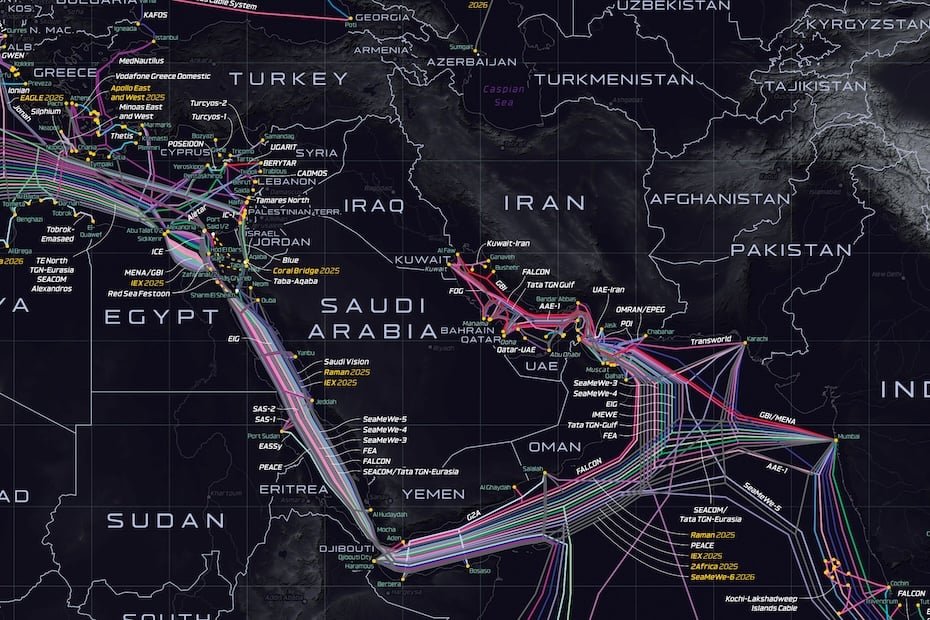
Image: Submarine Cable Map 2025 – Telegeography
Two of the most important undersea cables in global communications – SEA-ME-WE 4 (SMW4) and IMEWE – were damaged near Jeddah, Saudi Arabia over the weekend, disrupting connectivity across the Middle East, South Asia and parts of Africa.
Read more: Slower internet in UAE, wider region amid Red Sea cable cuts
While service providers worked to reroute traffic to keep networks running, the incident has highlighted just how crucial these systems are to the world’s digital economy — and how fragile the infrastructure beneath our oceans can be.
SEA-ME-WE 4 (SMW4) and IMEWE are key arteries of global connectivity, carrying a large share of data between Asia, the Middle East and Europe. They support everything from cloud services and video streaming to airline booking systems and international banking.
Fortunately, there are dozens of submarine cables serving the GCC. Industry mapping by Equinix counts 34 subsea cable systems landing at 18 cable-landing stations on the Arabian Peninsula, while TeleGeography’s interactive map shows a dense cluster of systems landing on the Arabian Gulf and the adjacent Arabian Sea coasts (UAE, Saudi Arabia, Bahrain, Qatar, Kuwait, Oman).
When a cable is damaged, network operators typically reroute internet traffic through other regional systems, using backup capacity built into the global network. This redundancy prevents a total blackout and keeps most services online. However, the alternative routes are often longer or already near capacity, resulting in slower speeds, higher latency and occasional service disruptions.
The Red Sea corridor itself carries about 17 per cent of global internet traffic.
At the time of writing, it’s not clear how SEA-ME-WE 4 (SMW4) and IMEWE were damaged. But listed below is an explainer of why these cables are important.
SEA-ME-WE 4: a 20,000km superhighway
The South East Asia–Middle East–Western Europe 4 (SEA-ME-WE 4) cable is one of the world’s most extensive submarine fibre-optic systems. According to Submarine Networks, it stretches between 19,200 and 20,000km and connects 14 countries: Singapore, Malaysia, Thailand, Bangladesh, India, Sri Lanka, Pakistan, UAE, Saudi Arabia, Egypt, Italy, Tunisia, Algeria and France.

The system has been operational since December 2005 and is owned by a consortium of 16 telecom operators, including Etisalat (UAE), STC (Saudi Arabia), Tata Communications (India), Singtel (Singapore) and Telecom Egypt.
When first launched, SMW4 had a total design capacity of 1.28 terabits per second (Tbps) across two fibre pairs. In 2015, Mitsubishi Electric upgraded the system to 4.6 Tbps, and in 2024 it was modernised with Ciena’s WaveLogic 5 Extreme, enabling up to 450Gbps per wavelength, according to vendor releases published by the likes of Ciena and Mitsubishi.
SMW4 plays a key role in linking Asia to Europe, forming part of the backbone that supports mobile operators, cloud services and international communications. Although newer systems like SEA-ME-WE 5 and 6 have been built, SMW4 remains an essential backup and redundancy route for the region.
IMEWE: Bandwidth from India to Europe
The India–Middle East–Western Europe (IMEWE) cable complements SMW4 by providing additional bandwidth along a similar route, with more direct connections. According to TeleGeography’s Submarine Cable Map, IMEWE spans approximately 12,091km and links India, Pakistan, the UAE, Saudi Arabia, Lebanon, Egypt, Italy and France.
IMEWE went live in December 2010 and is run by a consortium including Bharti Airtel, Etisalat, Orange, STC, Tata Communications, Pakistan Telecom and Telecom Italia Sparkle.

The system launched with three fibre pairs and a total capacity of 3.84 Tbps, which was upgraded over the years: to 4.8 Tbps in 2012 through 40Gbps DWDM technology, to 5.6 Tbps in 2016 via 100Gbps DWDM, and then enhanced again in 2019 with Ciena’s WaveLogic Ai, enabling 200Gbps per wavelength, according to Submarine Networks and TeleGeography.
IMEWE provides a direct, low-latency path between India and Europe, crucial for sectors that rely on real-time connectivity, such as finance, cloud computing and aviation.
Submarine cables such as SMW4 and IMEWE are feats of engineering. Each contains multiple hair-thin optical fibres encased in layers of steel, copper and waterproof insulation. Data travels at roughly two-thirds the speed of light, making these cables faster and more reliable than satellites. Modern systems can carry tens of terabits of data per second, enough to stream millions of HD videos simultaneously.
The Red Sea’s shallow waters and heavy shipping traffic make it especially vulnerable to accidental damage. In early 2024, three cables were severed after a vessel struck by Houthis drifted into a protected cable zone, causing weeks of disruption, according to Reuters.
Repairing these systems is complex and costly. The International Cable Protection Committee (ICPC) estimates that each fix costs $1m to $3m and can take weeks or even months, depending on depth, weather and the availability of specialised cable ships.
To improve resilience, operators are investing in next-generation systems such as SEA-ME-WE 6, which promises higher capacity and built-in redundancy.
But as global data usage continues to surge, older systems like SMW4 and IMEWE will remain critical for years to come.
