

Good morning, and welcome back to Europe Express. I hope you had a terrific break — or better still, are reading this while still on the sunlounger. For those who totally switched off, the summer was much like the rest of 2025: Donald Trump said: “Jump!” and Europe replied: “How high?”, on a lopsided trade deal and a school trip to the White House.
Today, our Canada correspondent reports on Mark Carney’s Eurotrip this week, and our climate correspondent explores the financial windfall from Brussels’ carbon border tax.
Friends with benefits
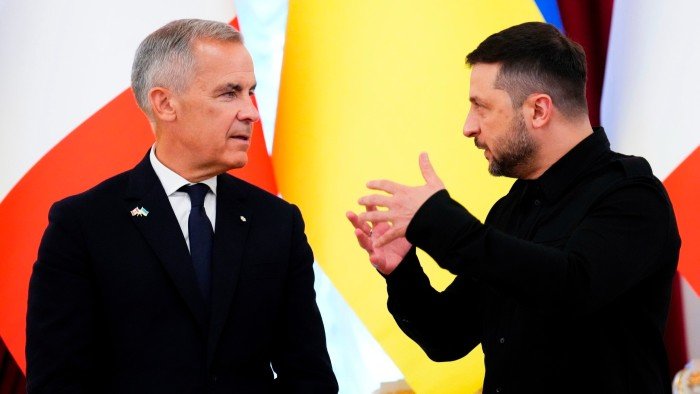
Five months in office, four trips to Europe: Serial visitor Mark Carney is back on this side of the Atlantic once again this week as the Canadian prime minister drives home his pitch for even closer co-operation, writes Ilya Gridneff.
Context: The EU and Canada have always been largely aligned but the impetus on both sides to deepen ties has surged following US President Donald Trump’s return to power.
Today Carney, a former governor of the Bank of England, is in Poland to meet Prime Minister Donald Tusk. That follows yesterday’s trip to Kyiv to mark Ukraine’s Independence day. Tomorrow he will head to Germany to make a joint declaration with German Chancellor Friedrich Merz on critical mineral supply chains for defence and automotives.
In Kyiv, Carney said drones, armoured vehicles and other munitions are headed to Ukraine as part of a C$2bn (€1.2bn) military aid package that will start being delivered next month.
This latest Europe trip comes after Canada on Friday dropped the 25 per cent tariff it imposed on many US goods since March. Steel and aluminium duties remain.
On Wednesday, Carney will be in Latvia, where Canada has deployed approximately 2,000 soldiers as part of a Nato mission — its largest overseas military contingent — aimed at deterring Russian aggression.
Diversifying Canada’s trading relationships with allies in Europe, Asia and Latin America is key to Carney’s agenda of building “the strongest economy in the G7”. It is also an effort to insulate against Trump’s tariffs that exposed an over-reliance on the US economy that roughly equates to C$1.3tn a year.
So bringing Canada closer to Europe is a “top priority”, according to a government briefing note.
Last week, Mélanie Joly, Canada’s industry minister, was on a similar mission to Nordic nations, seeking to buy more military kit from the likes of Sweden and Finland to offset its trade and defence dependence on the US. In June Carney signed a defence partnership with the EU in Brussels.
But despite the good vibes, trade tensions remain and lucrative deals remain elusive.
Ten EU member states out of 27 have still not ratified a free trade agreement with Canada (Ceta) signed nine years ago, which reduced tariffs on goods and opened up services.
Chart du jour: Save me

Germany is encouraging parents to invest €10 a month in pensions for children. Can it save the country’s creaking public pension system?
Raking it in
The EU’s carbon border tax could earn the bloc up to €11.3bn annually if other countries keep trading with the EU “as usual”, according to a new report seen by Alice Hancock.
Context: The Carbon Border Adjustment Mechanism is one of the EU’s most groundbreaking — and controversial — climate policies. The levy will apply from 2026. Importers will be expected to pay for the carbon emissions of imports into the EU at a cost benchmarked against the EU’s emissions trading system.
The report, published today by think-tank Sandbag and the Konrad Adenauer Foundation, said that the headline €11.3bn cost to third countries would in reality be reduced thanks to the extra revenues generated by selling products at a higher cost. It could be cut to €715mn per year if other countries introduce their own carbon price at €50 per tonne of carbon dioxide released.
The development of CBAM will make up a critical part of the autumn’s work for the European Commission’s climate and tax directorates.
The commission is consulting on which downstream products to include within CBAM’s scope, which currently includes cement, iron and steel, aluminium, fertilisers, electricity and hydrogen. It is also looking at anti-circumvention measures and whether to update rules on state aid compensation for high electricity costs within the EU as a result of its carbon price.
A final element will involve working on ways to protect heavy industry being undercut by cheaper, less green alternatives in their export markets, a senior EU official said.
The commission’s carbon pricing task force — a diplomatic outreach group helping other countries set up their own emissions trading systems — is also increasing its work.
Carbon pricing could play a major role at this November’s COP30 climate conference in Brazil. Brazil, a major EU trading partner, recently signed into law its own emissions trading system.
What to watch today
-
Canadian prime minister Mark Carney visits Poland.
Now read these
Are you enjoying Europe Express? Sign up here to have it delivered straight to your inbox every workday at 7am CET and on Saturdays at noon CET. Do tell us what you think, we love to hear from you: [email protected]. Keep up with the latest European stories @FT Europe
