

Unlock the Editor’s Digest for free
Roula Khalaf, Editor of the FT, selects her favourite stories in this weekly newsletter.
Carmakers and shipowners have called on the Trump administration to rethink steep new port fees on car-carrying ships, arguing that the levies will hurt American consumers and exporters.
The barrage of complaints come after Washington in April announced new port fees it said were designed to revitalise the US shipbuilding industry and combat China’s growing dominance in the sector.
The World Shipping Council and major US companies including Ford and Caterpillar have warned that the levies will be costly and counter-productive, in response to a US Trade Representative (USTR) industry consultation that closed on Monday.
The USTR initially proposed a $150 “per car” fee on non-US built vehicle carriers docking in America, before partially relenting last month following pressure from the industry, which warned the measures would wreak havoc on the $150bn American seaborne car import market.
However the new model — a $14 “per net tonne” fee which is due to come into force on October 14 — could still cost an average of $600,000 per vessel, according to calculations submitted to USTR by the Alliance for American Manufacturing, a trade group, in its own consultation response.
“The proposed fees are retroactive, uncapped and will not remedy the behaviour the USTR wants to curb,” said Joe Kramek, chief executive of the World Shipping Council, the trade association for the international industry.
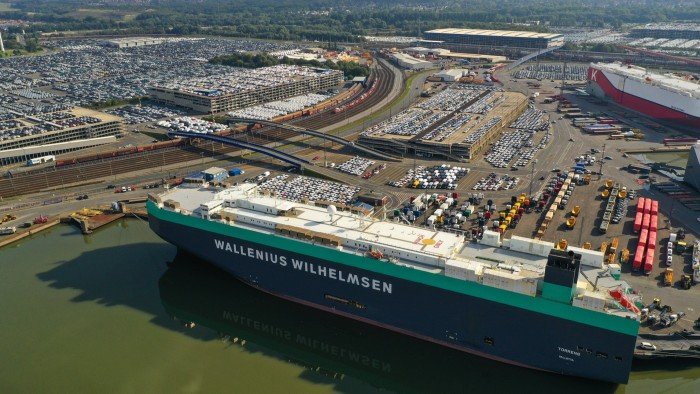
Late last month, Lasse Kristoffersen, chief executive of Norway’s Wallenius Wilhelmsen, operator of the world’s biggest car-carrier fleet, told the Financial Times that the proposals were hampering his company’s ability to handle US exports.
Kristoffersen said: “This rule decreases the competitiveness of US exports,” adding it was “something we’re working on”.
Other groups pointed out that the USTR decision to apply the port fees to all non-US built car carriers, rather than just to Chinese vessels, could inadvertently strengthen China’s dominance in the market, rather than reduce it.
Autos Drive America, an industry lobby, told USTR that in reality it would be “years” before the US shipbuilding industry could deliver sufficient numbers of US-built vessels to offer a viable alternative to the industry.
“Any fees to incentivise use of such [US-built] vessels cannot serve their purpose if US alternatives are not available,” they added.
Automaker Ford said in its own submission that the US government should “target only Chinese-built vehicle carriers”, adding that the decision to target all vessels, regardless of ownership, “unduly burdens Ford and other US automakers that rely on non-Chinese built vehicle carriers:”
Texas-based Caterpillar, a net exporter of mining equipment and other heavy machinery, in turn said the proposed fees could lead to “fewer vessels at fewer ports” resulting in reduced options and higher costs to export our US-made goods.
“These fees will . . . disincentivise vehicle carrier operators from serving the US and could lead to cost increases for consumers and difficulty for US exporters to get products overseas,” they added.
The National Retail Federation agreed, saying the fees would “not deter China’s broader maritime ambitions” but instead would “directly hurt” American businesses and consumers. “These fees will be passed along directly to the cargo owners, US importers and exporters to pay,” it wrote.
