

Stay informed with free updates
Simply sign up to the Climate change myFT Digest — delivered directly to your inbox.
John Warlters, chief executive of the charity Rural Aid, helped to unload 150 tonnes of hay in the remote Kangaroo Island off the coast of South Australia in June.
It is the first time his charity has delivered fodder to the island — known as one of Australia’s leading food producing regions, specialising in honey, oysters, eggs and meat — but its farmers have struggled with a damaging drought that has hit the southern half of Australia for the past two years.
“It’s exceptionally dry down here,” Warlters says. “I’ve been speaking to 70-year-old farmers today who have never seen it as it is now. It’s symptomatic of what’s happening on the mainland.”
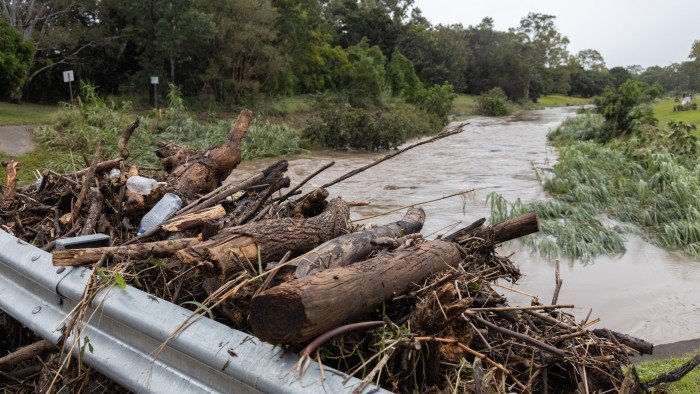
Many Australians outside rural areas may not realise how tough the drought has been as it was overshadowed by flooding and cyclone activity in the north of the country.

In New South Wales, the government was forced to react to both worsening drought conditions in the Bega region — which produces much of Australia’s cheese — and heavy flooding in tourist areas in the north, which were starting to recover from floods three years ago. Those came on the back of bushfires in 2019 and 2020.
Prime minister Anthony Albanese said in May that such events are growing more common, testing Australia’s ability to cope. “Dealing with the cyclone off the coast of south-east Queensland and northern New South Wales a short time ago, dealing with flood but also dealing with drought in parts of South Australia, Victoria and Western Australia at the same time tells us how vulnerable we are to these events, to climate change,” he said.
Also in Asia-Pacific Climate Leaders
The cost of climate change is growing more pronounced for banks, insurers, the government and citizens who live in areas that are fast becoming uninsurable. After Tropical Cyclone Alfred hit the north-east coast in March, the country increased funds for natural disaster relief to A$13.5bn ($8.8bn) in the budget and allocated A$1.2bn to prepare for further natural events. That is in addition to millions of dollars budgeted for coastal and bushfire protection.
Meanwhile, insurers said that losses from the recent cyclone and flooding had topped A$1.2bn. That has become a systemic issue for the economy, with the Climate Council calculating that 2.5 per cent of properties across the country are at high or medium risk of riverine flooding by 2030.
Jack Thrower, an economist with the Australia Institute think-tank, says 2mn citizens live in uninsured homes, and risk losing everything. “Banks in Australia hold over $100bn [$65.5bn] in mortgages on inadequately insured properties. Not only does this pose a risk to indebted homeowners, it’s also a risk to the health of the Australian economy.”
Martijn Wilder, chief executive of investment and advisory firm Pollination, says that a state suffering droughts and floods at the same time was an example of the growing threat. He argues that the regularity of floods, fires and droughts means climate change is now a clear financial risk in the annual reports of banks and insurers. He points to Cyclone Alfred skirting close to Brisbane as evidence that extreme weather is no longer only a threat to those in the regions.
“One of the challenges is volatility,” he says. “Australia is a very big country with huge divergence. It requires a far greater skillset.”

From a policy perspective, the country has moved to better prepare those in vulnerable regions — a need that has long been recognised in the agriculture sector.
Neil Waterson, a beef farmer in Bega, says that understanding of how to use data and other methods to prepare for drought has improved.
“It’s always coming. You know you’re going to have to start to prepare. One drought ends and another begins,” he says, mentioning work he has done on soil management with the local “drought hub” to protect ground cover.
Cindy Cassidy, a director of the Southern New South Wales Drought Resilience Adoption and Innovation Hub, says hubs have been set up across the country to prepare communities to cope with disasters, whether by water management and supply or adopting technology to monitor tanks.
The hubs have developed an online dashboard that compiles 100 data points — ranging from community services to mortgage stress — so that residents can see vulnerabilities.
“Flood, fire and drought are features of the Australian environment. Farmers understand that and as the climate becomes more volatile they recognise those challenges and how to deal with [them]. Australia is a leader in climate adaptation but we need to supercharge that,” she says.
On Kangaroo Island, Warlters says investment in programmes such as the drought hub show that Australia is thinking about the bigger picture rather than just reacting to disaster, and that the threat is likely to drive innovation.
“There’s strategic intent,” he says. “It’s a model that can deliver and will give other countries a good feel of how we respond . . . When there’s a green tinge, there’s hope.”
