

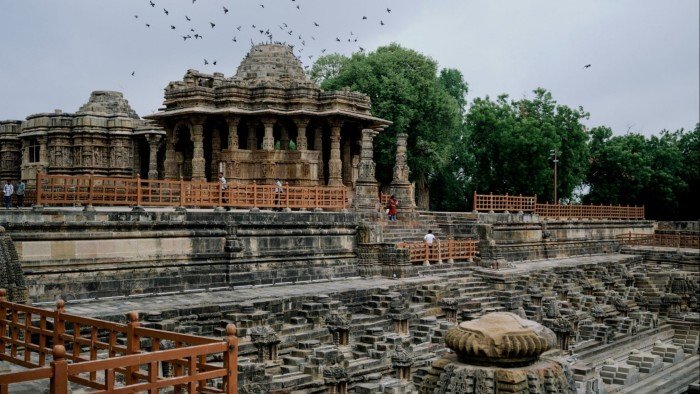
For a millennium the Hindu Sun Temple of Modhera has inspired devotees who pay tribute to the solar deity Surya. Now, the sun is giving back in the form of electricity by lighting up both the temple and the adjacent village.
The brainchild of Indian Prime Minister Narendra Modi — and his vision of “one sun, one grid” to power the world’s most populous nation — the village of Modhera in his home state of Gujarat, western India, has become the country’s first to run entirely on solar energy 24/7.
Home to more than 6,000 people, Modhera has an integrated system of over 1,300 rooftop panels on residential and government buildings, as well as carports, all connected to a power plant and a 15MWh battery energy storage system supplying uninterrupted electricity. During daylight hours, solar panel inverters supply power to the village, charge the batteries and export excess electricity to the national grid, while at night and in periods of solar energy deficit, power is supplied by the storage system.
The electricity bill of villager Bhupendra Singh Solanki, whose household of five faces the temple, has been slashed to almost nil since the project launched in 2022. “This should be replicated all over India,” he says.
Indeed, the government holds up Modhera as a model to be emulated across the subcontinent, says Rohit Patel, executive engineer at Gujarat Power Corporation Limited, owner of the $10mn project.

But there is a snag. Despite billions of dollars invested in solar farms by conglomerates such as Adani and Tata, there is a lag in storage capacity in the world’s fastest-growing major economy. “Currently there’s more power generation than storage in India,” Patel adds.
The situation typifies the complexities the country faces in its green energy revolution. In India, the world’s third-largest carbon dioxide emitter after China and the US, billions of dollars are being poured into projects to meet a government target to more than double non-fossil fuel power sources, including solar, to 500GW by the end of the decade.
Also in Asia-Pacific Climate Leaders
Yet a shortage of storage facilities, due partly to scarcity of critical minerals and manufacturing capacity to make batteries, threatens Modi’s 2070 net zero pledge. The Ministry of Power estimated in 2023 that India will have storage capacity of 82GWh by 2026-27 — far behind the 336GWh it believes the country of 1.46bn people will need by 2029-30.
The subject is attracting growing attention from politicians and investors given the need to store electricity at a far greater scale to smooth out intermittent wind and solar supply. “The challenge with renewable energy sources arises due to their varying nature with time, climate, season or geographic location,” the renewables energy ministry said in a statement, noting that “energy storage systems can be used for storing available energy from renewable energy and further can be used during peak hours of the day”.
Deepak Thakur, CEO of Mahindra Susten, the clean technology arm of Mahindra Group, which manages the project, says: “What sets Modhera apart isn’t just its scale, but how seamlessly the system integrates rooftop panels, solar carports, battery storage, electric vehicle charging, smart meters and centralised supervisory control and data acquisition management. It’s not a museum piece — it’s a fully operational, replicable model.”
Renewable energy minister Pralhad Joshi said in January that “India is on track to become a global leader” in the field after the government last year launched the national Surya Ghar, or Solar Home, photovoltaic panel initiative, which has already surpassed 850,000 rooftop installations, with the aim of powering 10mn homes in the coming years.

But Thakur warns that the Modhera model now faces a “moment of truth” as India is “increasingly flooded with solar power from 12pm to 6pm — but without sufficient storage, this surplus could go to waste or destabilise the grid.
“Modhera shows how to build distributed solar farms, rooftop systems and carport installations, coupled with smart integration and sufficient energy storage, to enable grid independence during non-sunny hours. Without energy storage, the goal of 500GW of renewables by 2030 could be compromised”, Thakur adds.
India’s government has acknowledged the need to swiftly expand energy storage by streamlining regulations, and tenders are under way. Power minister Manohar Lal Khattar this month announced a $627mn scheme to help close the funding gap for battery storage systems.
Debmalya Sen, president of the India Energy Storage Alliance, an industry group, says: “ . . . in the evening hours, when you need the power, demand increases, the solar energy plummets — that’s when you need the storage to kick in. You need the batteries to cater to your peak demand, otherwise you will still rely on coal plants.” India remains wedded to coal power for more than 70 per cent of generation.
Addressing lack of manufacturing capacity and critical minerals are key challenges for storage. As part of its “Make in India” initiative, Modi’s government recently introduced a $2.1bn production incentive scheme to manufacture locally 50GWh of advanced cell chemistry batteries.
India has also launched a “critical mineral mission” and is looking for partnerships with countries to process and refine them. While lithium was only recently found in the disputed northern territory of Jammu and Kashmir and the central state Chhattisgarh, India has been closing mining deals with countries as far afield as Argentina and Chile to secure the minerals it needs — especially lithium — to meet green energy targets.
But “the future of energy isn’t just lithium,” says Thakur. “Our current strategy relies heavily on lithium ion, but the long-term resilience of India’s renewable ambitions depends on exploring alternative storage technologies,” such as long-duration energy storage to mitigate supply chain vulnerabilities.
For Thakur, Modhera is a showcase and a call to action. “India can scale this integrated solar-plus-storage model only if we expand and diversify our storage capacity.”
