

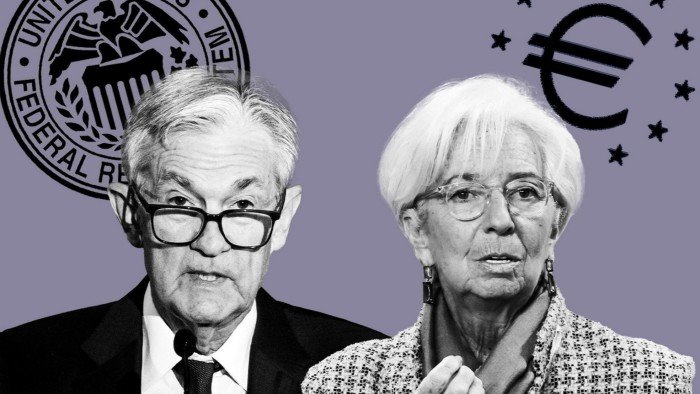
It is hot and the top central bankers have arrived in Sintra, Portugal for the European Central Bank’s annual forum. I am also there and will report on relevant papers and discussions next week.
At the start of the conference, the ECB announced the result of its five-year strategy review (more on that later). But one of the key themes for central bankers here is how to communicate when the shocks are large and the world uncertain.
It has not been a vintage week in central bank communications.
A shadowy figure
Since he was merely a potential candidate to become US Treasury secretary last year, Scott Bessent advocated creating a shadow Federal Reserve chair so that if Donald Trump came back to the White House, he could get the monetary policy he wanted.
Bessent told Barron’s magazine last October: “You could do the earliest Fed nomination and create a shadow Fed chair . . . and based on the concept of forward guidance, no one is really going to care what Jerome Powell has to say any more”.
That did not happen, and there is no doubt the US president really cares about what Powell says and does. Yesterday, he took to posting handwritten abuse in large letters on a weird league table of short-term interest rates and putting it on social media. It reads: “Jerome, you are, as usual, ‘too late’. You have cost the USA a fortune — and continue to do so — You should lower the rate — By a lot! Hundreds of billions of dollars being lost! No inflation — Donald Trump.”
Let’s face facts. This is brilliant communication. It is absolutely clear what Trump wants.

How does this affect Bessent’s shadow Fed idea?
Last week, everyone got excited when the Wall Street Journal reported that Trump was toying with the idea of an early Fed pick to be a back-seat driver on rates. “I know within three or four people who all I’m going to pick,” the president said at the Nato summit. At the end of the week, he told journalists the key qualities the next Fed chair would need to display: “I’m going to put somebody that wants to cut rates. There are a lot of them out there,” he said.
Financial markets increased their bets on quarter-point rate cuts in 2025 on the back of these comments from two to three, and the same number again in 2026, as the chart below shows.

There is no subtle way of describing this idea. It is terrible. It sets up multiple communication challenges for the US administration and the Fed, while almost certainly undermining the credibility of the Fed and the next chair.
Imagine the possible scenarios.
Trump picks a sycophant. The FOMC could, of course, capitulate and cut rates soon, undermining its credibility. For sure, it would justify this with some invented economic reasoning, but no one with any critical faculties would be reassured. Fed independence would be dead.
Since that is such a bad scenario, the FOMC would be likely to resist and carry on as if nothing had happened. This would be the right thing to do, but it does not solve the communication challenges. If Fed governors and regional Fed presidents vote with Powell until May and then fall into line with a new dovish chair next June, it would demonstrate that FOMC discussions and everyone on the committee is pointless apart from the chair. Credibility also dies.
If instead, they stand their ground now and after the new chair arrives next June, either outvote him or persuade him to change his tune (it is likely to be a man), it will be the new chair, not Powell, that becomes the lame duck. Many people would cheer, but this would not be a good outcome for the Fed.
If the nominee refused to be extremely dovish ahead of starting the job, he might find himself fired before being fully hired.
Recognising that this is not the genius plan he thought it was last October, Bessent has been backpedalling as fast as he can. When asked on CNBC (9 mins, 30 secs) about a shadow Fed chair on Friday, he said “I don’t think anyone’s necessarily talking about that”. I enjoyed the switch to the present tense.
The return of team transitory
One of the candidates in the running for chair is Fed governor Christopher Waller. He recently went on TV to call for “good news” rate cuts as early as this month. His argument is that US interest rates at 4.25 to 4.5 per cent are well above neutral levels, so there is not much danger in lowering them.
Waller laid this out more fully in a speech last month in Seoul in which he forecast that any rise in inflation from tariffs would be “transitory” — deliberately using the word that got the Fed into hot water in 2021 and 2022.
I do not have a problem with Waller’s belief that the Fed should look through higher inflation (although his argument was undermined somewhat by data on Friday showing stronger than expected price rises in May). The problem about using the “t” word is that it makes assumptions about pass-through and persistence no central banker can know.

The lesson from 2021 is to be wary about predicting transitory inflation, and instead to talk about your commitment to price stability and what you will do to ensure it lasts.
Inappropriate ECB
In what was mostly a backslapping affair, the ECB’s governing council has just approved its monetary strategy review. Sorry, I should call it an “assessment” because, as ECB president Christine Lagarde said, there was “no reason to revisit core pillars” of policy. So it cannot be a “review”.
The main points are that little changes: the inflation target stays at 2 per cent and policy reacts symmetrically to deviations around it; all the tools the ECB has used remain available; and this will be robust, the central bank thinks, in an era of more supply shocks and inflation volatility.
It is odd that the speeches and all the material explaining the assessment are so self-congratulatory. The ECB was late to end quantitative easing and raise interest rates in 2021 and 2022, hemmed in by past commitments. It vaguely accepts this. Buried deep in the monetary policy strategy document, officials accept the way they had designed QE had neither been forward-looking enough, nor foreseen the losses the ECB imposed on taxpayers.
But those moments of self-reflection were exceptions. Looking towards the future, Lagarde said the new approach would require “appropriately forceful or persistent monetary policy action in response to large, sustained deviations of inflation from the target in either direction”. She went on to stress the word “appropriately”.
There is no word that I dislike more to describe policy than “appropriate”. It is utterly devoid of meaning; no official would ever say they were acting “inappropriately”.
The following is absurd, but no different in substance from the conclusion of the strategy assessment:
The ECB will take the right decisions at the right time for the right reasons and later it will judge it was right to do so.
ECB messes up on the socials
At the same time it was congratulating itself, the central bank was using inappropriate images on social media. Having had an assessment that said the “inflation environment will remain uncertain and potentially more volatile, with larger deviations from the symmetric 2 per cent inflation target”, its communications experts in Frankfurt should have taken a closer look at the following picture they posted.
It shows a woman on a tightrope with certain death either side, suggesting any deviation from 2 per cent inflation spells imminent doom.
If you can’t get your visual metaphor correct, how are you going to run monetary policy?

What I’ve been reading and watching
-
The OECD’s groundbreaking international tax agreement, designed to stop companies shielding profits in tax havens, is in trouble as the G7 agrees to give exemptions to US firms.
-
The FinRegRag blog finds some differences between Powell’s comments to the Senate Banking Committee on the Fed’s plans to refurbish its buildings and the proposals it submitted. Marble, fountains and special elevators are involved, but not beehives.
-
Turkey’s economic struggles are making life difficult for President Recep Tayyip Erdoğan.
-
My colleague at Monetary Policy Radar, Andrew Whiffin, argues that the Fed might need to make further changes to banking regulations if it wants to ensure a functioning Treasury market.
A chart that matters
The Bank of England is facing ever louder calls to curb its bond-selling quantitative tightening programme when it makes a decision on how much to scale back the balance sheet in September. With fewer of the bonds it holds maturing in 2025-26, it needs to sell £52bn in the year from October, compared with £13bn this year, to keep QT at the £100bn-a-year pace.
Perhaps markets are complaining too much. The chart below shows that the BoE’s share of bond issuance is tiny compared with that of the government.
The one exception might be in long bonds, which the BoE defines as having a maturity of more than 20 years. The UK government’s Debt Management Office is also scaling back long-date gilt issuance. Not to get in its way, the BoE might choose to take the easier option of selling more medium- and short-term bonds.

Central Banks is edited by Harvey Nriapia
