

Unlock the Editor’s Digest for free
Roula Khalaf, Editor of the FT, selects her favourite stories in this weekly newsletter.
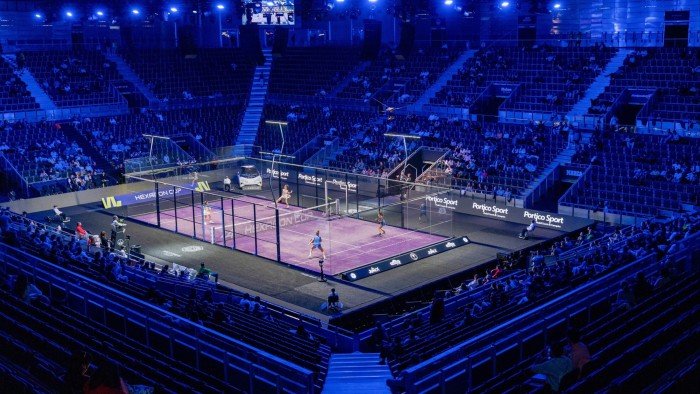
The organisers of the Hexagon Cup padel tournament are planning to set up a network of amateur leagues around the world, in a bid to tap into the soaring grassroots popularity of the sport and boost the long-term audience for their annual five-day elite event.
Padel, which was invented in the 1960s by a Mexican businessman, has long been popular in a handful of countries, especially Spain and Argentina. But since the pandemic, the sport, which mixes elements of tennis and squash and is played in a glass-walled court, has been growing rapidly in Europe and the Middle East.
A report produced last year by consultants at Strategy& for booking app Playtomic, projects annual growth in the number of courts globally in the next three years of 17 per cent, with the total number expected to reach almost 70,000 by the end of 2026.
The Lawn Tennis Association, which oversees the sport in the UK, expects the number of padel courts in the country to reach 1,000 later this year, up from under 500 at the start of 2024.
Much of that growth has come thanks to a push by traditional tennis clubs to increase membership by installing padel courts.
But rather than seeing padel as a threat to tennis, the LTA sees the two growing in tandem, with racket sport novices potentially trying out padel as an easier entry point before going on to play tennis.
Amid the surge in interest, the Hexagon Cup was launched in Madrid in 2024 by the founders of Formula E and the E Series powerboat circuit, with the aim of creating an elite contest pitting the world’s best professional padel players against each other in a team format.
Much of the inspiration came from the Laver Cup, an annual tennis contest in which Europe takes on the rest of the world. But the competition has also drawn lessons from other sports such as basketball, where NBA players are picked through a draft system.
The tournament involves eight celebrity-owned teams, each consisting of three doubles pairs — one men’s, one women’s, and one youth. The winning team collects €1.2mn, the biggest prize pot in padel.


Team owners include retired tennis stars Rafael Nadal and Andy Murray, footballers Lionel Messi and Sergio Aguero, F1 driver Pierre Gasly and Hollywood actress Eva Longoria. The hope is that these celebrities will help to boost interest. This year’s event attracted over 30,000 spectators, and aired for free through streaming service DAZN.
“For the moment, the strategy is reach rather than revenue. We are trying to get us to as many households as we can”, says Enrique Buenaventura, one of the Hexagon Cup’s founders.
Beyond the pull of a famous name, the idea is to build team identities around nationalities, such as in F1 with Italy’s Ferrari, which then feeds through to fans in target markets.
More from The Business of Tennis
Buenaventura says the company is now working with Playtomic to establish amateur leagues in countries with a well-established or fast-growing padel community. It has already acquired a league in Spain, and hopes to grow across the world starting with the UK and South Africa.
“We want to start creating that link between the amateurs and the professional world. The plan is to launch in the places where Playtomic has a big presence, and then make it global,” he says.
Much of Hexagon Cup’s revenue comes from commercial partnerships, including from motor group Alpine — the title sponsor — Spanish beer brand Mahou, and sports brands Adidas, Babolat and Slazenger. The move into amateur padel is partly to increase the opportunity for those partners to reach the growing padel community directly, says Buenaventura.
“Sponsors are super interested”, he says. “They’ve been able to sponsor the big, professional events, but now also the grassroots where there are . . . thousands of people playing every single day.”
FT Scoreboard

Scoreboard is the FT’s weekly briefing on the business of sport. Sign up at ft.com/scoreboard
A wave of investors is looking to tap into the potential growth of professional padel. Those backing the Hexagon Cup include DMG Ventures, the investment arm of the Daily Mail publisher, while earlier this year Hexagon Cup signed a strategic partnership with Premier Padel, a Qatari owned circuit.
As part of that agreement, Hexagon Cup could expand into other parts of the world with more tournaments, Buenaventura says, while it was also picked to run the sport’s first Intercontinental Cup, a new tournament in London based on golf’s Ryder Cup, pitting European teams against the Americans.
London was selected in part due to the growing hype around padel in the UK. At an average cost of €59 per hour, according to Playtomic, the city is home to the world’s most expensive courts.
