
Unlock the Editor’s Digest for free
Roula Khalaf, Editor of the FT, selects her favourite stories in this weekly newsletter.
Over the second weekend of May, Donald Trump sacked the head of the US Copyright Office. On the previous Friday, the office had released “Copyright and Artificial Intelligence Part 3: Generative AI Training”. For the “tech bros”, who had spent so much on bringing Trump to power, this report was a declaration of war: it cast doubt on the viability of the “fair use” defence, upon which Open AI, Meta and other tech companies rely for the unrestricted right to “scrape” online data when training their models.
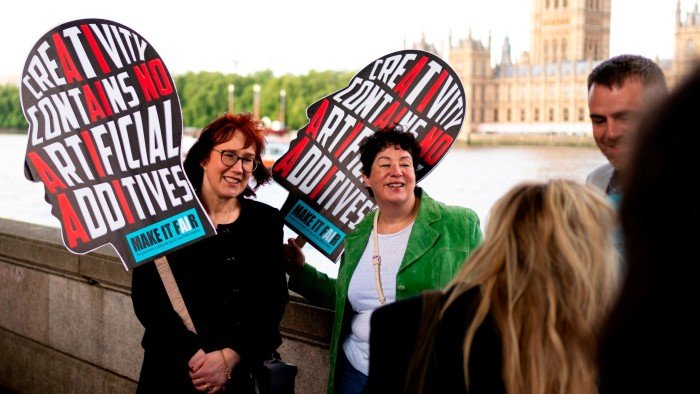
Copyright protection is just one of the many issues raised by the advances of AI. Following a government consultation, it is being fiercely debated within the British parliament, specifically between the government, which controls the House of Commons, and the House of Lords.
In the words of Baroness Beeban Kidron, who is leading the charge for copyright holders, “the government’s preferred option is to give away the property rights of those who earned them on the promise of growth, growth, growth to the nation. Unfortunately, the government cannot say to whom that growth will accrue or how much it will be. But the one thing they are absolutely sure of — government, opposition, AI companies and those whose property rights the government is giving away — is that it will not accrue to the creative industries.”
The underlying principles here are hardly controversial. We have agreed, as societies, that intellectual property should be protected. It is right that people should benefit from their labour. So, it is also right that the businesses that develop and publish books, music, films and so forth should benefit from their work. Moreover, it is not only right, but economically beneficial. It creates economic value. If companies wish to benefit from the creativity of others, they should pay them. That is why civilised countries recognise copyright.
At the same time, intellectual property in general and copyright in particular raise complex issues. One such issue is that of the appropriate duration of this property. In the UK, books, music and films are protected for 70 years after the deaths of the creators. This is arbitrary. But it is indubitably the law. Another issue is that of enforcement. As Kidron notes, creators have a right to know when their property is being “scraped”. Since the theft of copyright is now anonymous, holders cannot protect their rights. The big issue, then, is one of transparency.
The Starmer government says it is open-minded. But it has not rejected a “strip-mine whatever you wish” option. One reason might be that the UK should not irritate the American government, already a doubtful ally, by imposing transparency, since the tech companies own it. Another might be a belief that the economic gains from being friendly to the AI industry will outweigh the damage to its own creative industries. Yet another might be a suspicion that it would be impossible to make a demand for transparency work, in any case.
These are not absurd judgments. But there are important countervailing considerations. One is that the government itself estimates that “creative industries generated £126bn in gross value added to the economy [5 per cent of GDP] and employed 2.4 million people in 2022”. It is at the very least an open question whether the value added of the AI industry will ever be of a comparable scale in this country. Another is that the creative industries represent much of the best of what the UK and indeed humanity does. The idea of handing over its output for free is abhorrent.
We have also surely gone far beyond being able to give this industry the benefit of the doubt. Its motto is “move fast and break things”. Well, it has certainly broken things, among them, arguably, the mental health of young people, and, as I have personally experienced, through a “deepfake” of myself, control over the spread of financial scams.
Interestingly, for much of the 19th century, the US did not recognise international copyright at all in its domestic law. Anthony Trollope himself complained fiercely about the theft of the copyright over his books. “A bold assertion is made”, he wrote, “that they like to appropriate the goods of other people, and that as in this case they can do so with impunity, they will continue to do so. But the argument, as far as I have been able to judge, comes not from the people, but from the book selling leviathans, and from those politicians whom the leviathans are able to attach to their interests.” The leviathan are different. But the motive is the same.
As Kidron insists, there exists an opportunity for a good relationship between tech behemoths and the creative industries, “But this forced marriage, on slave terms, is not it.” I agree.
