

Stay informed with free updates
Simply sign up to the Climate change myFT Digest — delivered directly to your inbox.
Norway has launched the world’s largest full-scale operation of industrial carbon capture and storage, ploughing billions of dollars of subsidies into the venture to trap the emissions of highly polluting products such as cement.
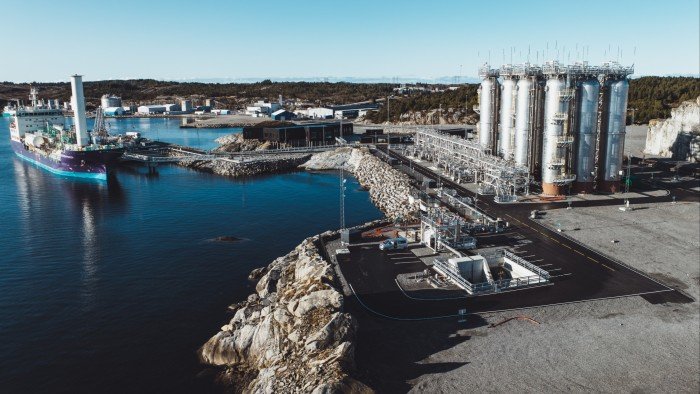
The first shipment of carbon dioxide left Heidelberg Materials’ plant in Brevik in southern Norway this month by ship, and will be injected in reservoirs under the North Sea in August by the Northern Lights consortium of oil groups: Equinor, Shell and TotalEnergies.
The cost of the Longship project for the first 10 years is estimated at NKr34bn ($3.4bn), of which the oil and gas rich Norwegian state is subsidising NKr22bn. It is set to store 5mn tonnes of carbon dioxide under the sea, a small fraction of the more than 2.5bn tonnes of emissions produced annually by the cement industry.
“The green transition is not easy, but it is possible,” said Terje Aasland, Norway’s ministry of energy as he started the project.

Proponents of CCS argue that it is the most promising solution for so-called hard-to-abate sectors — such as cement, steel and coal-fired power — to eliminate their emissions. But critics contend that it is a costly process, difficult to scale and dependent on massive subsidies. These are often difficult for most cash-strapped governments to provide, except for the likes of Norway, western Europe’s largest petroleum producer and home to the world’s largest sovereign wealth fund.
“For us, this project would have been impossible without the support of the Norwegian government. The risk would have just been too high,” said Dominik von Achten, chief executive of Heidelberg Materials, the German industrial group.
He told the Financial Times that it had debated marketing its “evoZero” product as something other than cement as it tries to justify a high but unspecified green premium for the product.
The Longship project will capture about 400,000 tonnes of carbon dioxide annually from its Brevik plant and from 2029 is set to add 350,000 tonnes from a municipal waste plant in Oslo. Norway’s government on Tuesday gave the green light for the second part of the project, which will increase the storage capacity from 1.5mn tonnes under the sea to 5mn tonnes.
Europe has struggled to compete in certain green technologies, including batteries, as governments have hesitated over giving generous state support to companies such as Northvolt, which went bankrupt in Sweden earlier this year.

Jens Stoltenberg, Norway’s current finance minister, called CCS the Nordic country’s “moon landing” when he launched a big project in 2007 but it was subsequently cancelled due to spiralling costs.
Both Aasland and von Achten declined to say exactly how long it will take for subsidies to no longer be needed. But the Norwegian minister said that the price of carbon permits in Europe could become so high that it would be commercial within about 10-15 years.
Norway is hoping that companies such as Equinor will help develop a series of pipelines across Europe to lower the cost of transporting carbon dioxide from emitting factories on the continent to the North Sea.
Albert Rösti, Switzerland’s energy minister, said on Tuesday that CCS was “too expensive” for his landlocked country and that it would be the “last step” to meeting climate targets after easier measures such as cutting transport emissions. Nonetheless, he added: “It is not only theory, but Norway has gone to action.”
Climate Capital

Where climate change meets business, markets and politics. Explore the FT’s coverage here.
Are you curious about the FT’s environmental sustainability commitments? Find out more about our science-based targets here
